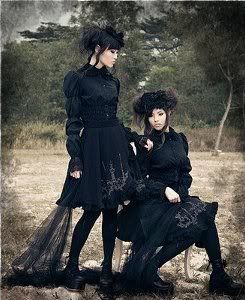
People may ask, "Why is it I have never seen a goth of color?" In other words, why is it the goth scene so predominately white?
Well, they have a point. The goth scene started in England with the gothic dance pop music of Joy Division. Joy Division in its own right grew out of the punk music scene, a primarily white, Anglo-Saxon protestant movement. Other gothic bands soon followed. Bauhaus, The Cure, Siouxsie & the Banshees, The Sisters of Mercy, The Fields of the Nephilim. As a progression from punk, goth is rooted in British history, politics, culture, and religion. Yet, as a romantic movement, goth moves away from just the social and political arena of England to touch upon more universal issues of loss, sorrow, isolation, and death. There are many references to religion, particularly Christianity, that reflect a more specific society. In some degree this is balanced with Greek, Roman, Norse, and Celtic mythology. Even still, the above represents only the religions of Europe.
In defense of homogeny in the scene, not all goths can be judged by their cover. Many goths, I would even go as far as to say most goths, do not fall into the established stereotype. Black eyeliner, black nail polish, wild hair, clove cigarettes, torn fishnets, ruffles - these are the outward features of the typical goth. Most goths I know may wear black, maybe a band T-shirt, but they don't go out of their way to goth it up. I like to call us basement or subdued goths (sub goths for short). Sub goths don't look goth, but they are. Even DJs and musicians in the scene can be basement goths. So, who is to say that a black man, an hispanic woman, or an Asian fellow isn't a subdued goth? There is more to it than just appearances.
Goth is about expression and sensibility. It is not limited only to the vampire aesthetic. Goth is an ever widening circle embracing many aspects of the dark side of life. Romantic goths embrace the high fashion and social customs of the Victorian or even Elizabethan age, only with a prominent penchant for black, mourning attire. Intricate lace, ruffles, top hats, canes, parasols, veils - these are the finery of the romantic goth. Deathrockers resemble something akin to a punker just freshly risen from the grave. Emphasis is on anti-fashion and horror. Gothabillies embraces the 50s aesthetic of bowling shirts, tweed, leather jackets, poodle skirts, and Betty Page. There are many subcultures within the scene, each with something else to offer a prospective goth.
Furthermore, discussion of race is a sticky topic to begin with. Although there appear to be sharp distinctions regarding national borders and cultural differences, the walls are thinner than one may think. Anthropologically speaking, science can trace our DNA to Africa. In short, we are all African. Each human can trace their DNA back to Africa. We are brothers and sisters one and all. During the ice age, massive glaciers used up much of the ocean water. The seas receded. This allowed early humans to travel across dry land that may once have been a river, a lake bed, a canal. Humans moved up into the Indus valley and eventually settled in Eurpoe and Asia. Humans evolved over time to adapt to the colder climates. Melanin evolved out of the skin and eyes. Fast twitch muscles atrophied in favor for muscles equipped for more prolonged activity. This is not to say whites and Asians are more evolved. Africans evolved parallel to Eurasia, only equipped to handle warmer climates. Even then there are distinctions between East an West Africans and well as differences between mainland Asians and Asians on the Pacific islands. When someone describes a custom or trait as black or white, latino or Asian, this has as much to do with genetic make up as it does environment. There are distinctions between different races that developed over time, but the essence of humanity remains the same.

ASIAN GOTHS
There are several emerging goth scenes in Japan, particularly in Tokyo. Gothic Lolita is a scene in which girls and women dress like dolls. The clothing is very detailed, similar to romantic gothic fashion, very intricate with frills and lace, only with a touch of anime. This scene has grown in popularity and is spreading to Europe, the U.S. and elsewhere. The other big movement is the cybergoth scene. Cybergoth is a blend of rave culture and the goth scene. Cybergoth is largely populated by rivetheads. DJ Sisen is a world renown Industrial/EBM DJ. Not only does she expose Tokyo to Skinny Puppy and Nitzer Ebb, she is a fashion ikon in her own right. She dresses in visual kei, wearing quite outlandish and colorful outfits and applique to her eyelashes, etc. Japan's greatest contribution to the goth scene has to be the fashion. The trends and designs in the visual kei arena definitely take gothdom in a new direction, taking dark fashion into this next millennium.
Musically, the goth music of Japan tends to be J-rock with horror elements. Marilyn Manson is often cited as inspiration for the scene. A J-goth band worth mentioning is Chako, an ethereal band from Kobe. The music is lush and sorrowful.
Chinese culture is not one for diverse expression, being a socialist nation. However, many Chinese Americans and other Chinese living outside mainland China follow the way of the goth. Goth is quite rare in the rest of Asia as well, finding expression only when apart from the dominant culture. Asian Americans and Asian Europeans are more likely to demonstrate gothic tendencies or have gothic tastes. This may have something to do with the immediate environment. If .

LATIN GOTHS
Mexico has had a long love for the vampire and other stories of dark romance. South America, too, possesses an air of mystery and wonder. The Aztecs and the Mayans are just as mysterious as the Druids and Celts of Europe. So it is little wonder that members of the Latino community would adopt goth as a culture. There is an hispanic gothic community in the Bronx. It is a tight knit group that had been featured in the New York Times. Of course, the members of this circle of goths have suffered persecution from parents, neighbors, and the like. These goths run the gamut from trad-goth to rivetheads.
And speaking of rivetheads, Hocico is an industrial band from Mexico City. They took inspiration from Skinny Puppy and similar bands. Their style is acerbic, yet beautiful, ranging from aggrotech to endzeit electro. Endzeit is usually limited to Germany. Hocico performs mostly in Spanish. They are getting more recognition all the time and currently tour all over the world. A number of other hispanics populate gothdom in one form or another.

AFRO-GOTHS:
Goths of African descent, or afro-goths, are fairly rare. However, they are not unheard of. According to an Internet pole, 51% have met an African American goth or emo. However, most of the yes answers are from the midwest and the south, both having in sum understandably less insight into the gothic community, and therefore more likely to give an incorrect answer.
A problem, especially in the U.S., is that there is a great deal of pressure on black Americans to hold onto their cultural heritage. As they did not come to America willingly, it is understandable that many African Americans resist complete assimilation. As such, they keep to the culture of Africa in music and dress. The biggest contribution to the black American experience is the development of a new culture. Blues, doo-wop, hip-hop, rap, and funk (and many would say rock & roll) developed in America as a means of black American expression. However, more and more white America emulates black culture. Vanilla Ice, Kid Rock, eminem. These represent stages of reverse assimilation. White kids disassociate with their white roots. Eminem is more widely accepted today than Vanilla Ice nearly 20 years ago.
The mistake is assuming that black goths are trying to appear white. Goth is not a white issue. Goth is about self-expression. The black goth is attracted to the same things as a white goth or a hispanic goth. Truly gothic folk tales have a rich, African tradition. Perhaps the person grew up in a white, suburban neighborhood and therefore lived the "typical" goth experience. Whatever the case, something appeals to the individual and draws him or her into the scene.
Sadly, many blacks still possess a misconception of goths, believing them to be racist skinheads, devil worshippers, etc. Although these elements do appear in the scene, they are not the scene. Just as some blacks are gangstas doesn't mean all are. There are black CEOs, black authors, black producers, black bankers, black physicists. Even in the rap community not all rappers are gangstas. The Rza is deeply into Eastern philosophy. The fact is there is a fair amount of resentment towards any kind of alternative culture in the black community, just as in other communities. Goths, being so very obvious, make an easy target. It is the same attitude white people had when members of their community started to adopt the black culture. Wiggers became the derogatory term for these individuals, sometimes even if they grew up in the same socio-economic environment. The black goth can be viewed as a traitor to her race.
Just the same, some afro-goths do overcome this opposition and express themselves fully at the expense of ridicule or exile. There is a black gothic Lolita community, embracing the Japanese goth aesthetic. There are black goths within the vampire community. The Vampire Club in New York features several regulars. Romantigoths, candy goths, death rockers, even gothic belly dancers all find a place in this small community. A considerable section is taken up by rivetheads. Industrial/EBM may have teutonic beats, but the content is mostly about politics and urban decay. These subjects are the same posed by Public Enemy and other rap artists, only the music is ever so slightly different. Even the technology is the same, lifting hooks and beats from other sources. Laying in samples from television, movies, and radio. Industrial music reflects the anger and frustration of living in a post-industrial society. One of the top cybergoth communities is based in Detroit, a city with a large black population.
An unexpected drawback of the African goth is difficulty finding a suitable life partner. Sure they could go outside the black community, but why should they if they don't want to? A black goth seeking a black goth must be a nightmare and I do not envy them for it. However, I do wish them the best of luck. Several websites are devoted to bringing together members of the black gothic community to offer support, to enlighten, and to accept. Many afro-goths come to the party late and have to play catch up. This means many questions asked regarding fashion, slang, customs, and music. For any aspiring afro-goth, I would suggest getting on Last.fm and entering the following tags. Goth, Gothic Rock, Darkwave, Ethereal, Industrial, EBM, Horrorpunk. This should provide you the opportunity to choose those artists that best fit your tastes.
Black goth bands are considerably rare. Code Industry is our best example. They were a politically charged, coldwave group in the early 1990s. Blacks have contributed individually to the goth-industrial scene. Reggae vocalist, Morgan Adjei, lent his stylings to KMFDM's album UAIOE on tracks like Murder and Loving Can Be an Art. On Front Line Assembly's album, Millennium, Che the Minister of Defense provides rap vocals to Victim of a Criminal. Duane Buford provided keyboard and spoken word vocals on Revco's Linger Ficken' Good.
It is disappointing that so few black musicians actively contribute to the goth scene. There is definitely room for goth from a black perspective. I would be interested to see what direction black musicians would take darkwave music. The contribution of blacks to medical science, music, film, and sport is considerable. The joy of goth is adaptability. Goth can be shaped to the viewpoint of the musician. Christian, pagan, sadomasochistic, satanic, romantic - a number of approaches are open for the aspiring afro-goth. Hopefully, the fans today will grow into the musicians of the future.
Black musicians have contributed to the goth scene even though they are not goths. Michael Jackson's Thriller, speaking as a goth, is a brilliant tribute to the horror scene. The lyrics refer to just about every cheesy creature feature of the 50s. The video equally addresses zombies, werwolves, and such. It is just good fun. Prince's outlandish costumes granted blacks the ability to dress similarly. Dressed in period victorian ruffles, one's peers would regard one as a Prince fan and not a goth. This is a mixed blessing, surely. Musically, goth owes a great deal to black culture. Reggae inspired punk, and punk inspired goth. Blues music, too, influences a good deal of early goth. Meanwhile, hip-hop and rap have inspired the new sound of Skinny Puppy as well as the aggrotech vocal stylings of Angelspit and the peculiar mash-up that is Stromkern. Tribal beats form the foundation of many goth songs, particularly by artists like Tigerlily and Drumatic.
The gothic-industrial scene has gone global. Bands, fans, and DJs live in or can trace their heritage to the following countries: Afghanistan, Australia, Austria, Belgium, Canada, Denmark, England, Finland, France, Germany, Greece, Ireland, Italy, Japan, Lebanon, Mexico, Norway, the Philippines, Scotland, Slovenia, South Africa, Sweden, the United States of America, and Wales. And this is just off the top of my head.
Occasionally, white goths receive venom from the ethnic goth community. White goths are condemned for being too homogenized. Same fashion, same music, same background. This attack fails to consider the broad range of goths within the white community. It seems a feeble attempt to validate the ethnic goth movement by creating a straw man argument. White goths are all the same so they are boring and irrelevant. Ethnic goths are all different and therefore interesting and relevant. Every white goth, and every goth of color I know, is a unique individual. There is no place in the debate for such baseless attacks. Allow those to express themselves as they choose fit just as you would permit yourself the same. The same person who says that all white goths look the same turns around and in the next breath says that racism has no place in the goth scene. I am left scratching my head.

 Wu wei is often translated as non-violence, which is not all that accurate. Better to say non-interference. It is a principle in Daoism of limited effort. Zen Buddhists call it skillful means. Athletes call it being in the zone. The central concept is to manage things successfully by doing as little as possible. Know when action is required and know when to keep your hands off. The perfect leader can rule a nation without seeming to do anything. The nation manages itself naturally. Of course, the ruler acts, but discretely and in the moment. He doesn't push things. To push is to meet with resistance.