Saturday, September 26, 2009

Cowboypunk?

In the InsideOutcast 8: the Infinity Strain, we paid tribute to the incomperable Nathan Fillion. One cannot discuss the roles of Mr. Fillion without mentioning Malcom Reynolds. Malcolm was the captain of a Firefly class vessel in the space western series, Serenity. Most should be familiar with the program, so I won't go into too great of detail on that. What I do want to touch on is the cross genre of space westerns, or as I like to call it, cowboypunk.

The term, cowboypunk, exists as a musical fusion of punk and country western music. It is also urban slang for a cowboy with a particular attitiude. However, cowboypunk, for me, is a derivation of cyberpunk, which also spawned steampunk, dieselpunk, and the like. Cyberpunk is classified as hard science-fiction taking place usually in the near future. Cyber refers to computers and technology while punk refers to common street people. As such, cyberpunk is a kind of science-fiction wherein the average street person has access to technology. Typically this include cybernetic implants, hi-tech weapons and vehicles, and advanced information technology.

Steampunk is a variation on a theme. Instead of being set in the near future, steampunk is set in an alternate Victorian setting, where steam power is more advanced. The clothing and language tends to be more Victorian, while the technology depends heavily on steam. Lighter than air vehicles abound. Also, a steampunk adventurer is not complete without a pair of goggles and fancy boots. Dieselpunk is a similar genre, only gas is used, of course. The Mad Max films come to mind. A lesser known genre is clockpunk, in which all technology is clockwork. This genre features clockwork robots and a lot of brass.

Following the trend of adding punk to whatever the technology of the day may be, cowboy punk, then, is science fiction with a definite western sesibility. For instance, cattle and horses still play an integral role. The language and dress reflects the wild west as well. Although technology is advanced, it still maintains a western look. For intance, the neighborhood bar may look like a saloon. Also, it is not uncommon to see people in cowboy hats and matching boots.

Cowboypunk is not new. Firefly was not the first series to address this genre, though probably the most popular. I remember the Michael Chrichton film, Westworld. Westworld was a tourist spot wherein one could experience life in a wild west town, only the robot gunslinger developed a glitch. The gunslinger, played by Yul Brynner, sought after the film's hero as that was his core programming. The obsessive, tireless pursuit of robot after hapless hero, in my opinion, may have influenced The Terminator film. The similarities are striking.

A cartoon series in the early to mid eighties really helped define the cowboy punk aesthetic. The Adventures of the Glaxy Rangers was a series about humans encountering alien species and developing faster than light travel. As they colonize the galaxy, special law enforcement units are required to oversee these new colonies. The Galaxy Rangers is heavily western themed, including the use of robotic steeds. One of the major characters, Shane Gooseman (Goose) is essentially Clint Eastwood. He is a genetically modified soldier and the only one of his kind to have not been driven mad by an experiment. Also accompanying this band of heros is a psychic/martial artist woman and a computer expert that has almost wizard like computer-based abilities. One of his programs is actually called Firefly.

Firefly took a more direct and realistic approach to cowboypunk. The concept of humans taking to the stars and forming colonies is very much like Galaxy Rangers, only no aliens and limited genetic alterations. Firefly nods its head in the direction of classic westerns. First, there is the war somewhat similar to the American Civil War, in which our heros were on the losing side. We have gunslingers and russlers and train robbers. We have small town sheriffs and ranchlands and brothels. The setting is very much western themed. Firefly also incorporates Chinese language and culture. This is interesting as the late 19th century saw a large influx of Chinese to American soil.

However, Firefly is also science-fiction. There are spaceships and blasters. There are holograms and supercomputers. There is also an evil empire reminscent of Star Wars and an escaped science experiment as seen in much Anime. Firefly blends the western with the sci-fi quite effectively, making it one of the most charming and entertaining (if not completely original) series of our lifetime.

On a final note, I think it should be mentioned that Star Trek was originally presented as a sort of Wagon Train in Space. The western element of exploring the frontier was very much in the hearts and minds of the creators of Star Trek. Even then, westerns and science fiction overlapped, creating one of the most influential science-fiction commodities of all time.

Sunday, September 20, 2009

The Psychology of the Tarot

In the InsideOutcast #7, we mentioned common misconceptions of the Tarot in film and television. These misconceptions often give the Tarot a disservice as it already suffers enough blame from the fundametalist Christians and others that fear the occult. Oddly, a French monk is attributed to having rediscovered the Tarot, which seems to have originated in Egypt. The Tarot entered such a fashion that parlor games evolved from the esoteric set of painted cards. The playing cards of today owe their existence to the Tarot. Games of poker, rummy, blackjack, and the like would not exist without the Tarot.

So what is the big deal? What is the fascination with the Tarot? What is the mystique? Frankly, it is how the Tarot relates to our lives. Carl Jung, early psychologist, studied the impact the Tarot had on the collective unconscious. The Tarot is replete in symbolic images and numerology that speaks directly to the deep recesses of our minds.

I will begin with the numerology of the Tarot and expand a little into the rest of the Major Arcana. The Major Arcana are 22 cards that reflect the life cycle of the average human being. It touches on our deepest desires, fears, hopes, and experiences. To determine your numerology, simply take your birthday and add up all the numbers until you come up with a number between 1 and 9. For instance, if your birthday is July 4th, 1776, add the numbers up to 32. 3 plus 2 is 5. The numerology is then 5. Following are descriptions of the numerlogical side of the Tarot.

1-The Magician. The image of the magician generally features an elderly man with a sword, cup, wand, and pentacle. This represents the magician's control over the four elements. The magician has incredible control. He is a multitasker, a networker, and a master communicater. He hearkens back to the human mastery of intercommunication and the power of the spoken word. He also has a deceptive side. The magician relates to the the 10th and 19th cards, the Wheel of Fortune and The Sun respectively. The wheel of fortune represents affecting positive change in your life while the sun represents vitality and energy. These two cards support the traits of the magician. Also supporting the magician are all the aces and tens of the lesser arcana. As such, the magician is the most complex and intricate of the numerological signs.

2-The High Priestess. The image is of a young woman, often blindfolded, sitted between two pillars. Above her the moon is shown in three phases, representing past, present, and future. The priestess embodies natural instinct, occult knowledge, and feminine mystique. There are Greek roots here as there is a direct connection to Artemis, Goddess of the moon, virginity, and the hunt. Supporting the priestess are the 11th and the 20th cards, Justice and Judgement respectively. One can see the importance of balance and equanimity here. A blindfolded woman holding scales remains the image of blind justice. This relates directly to the Tarot. All the number 2 cards of the lesser arcana also support the priestess.

3-The Empress. The image of the empress is one of a mother. The empress is productive and fertile, she is caring and influential, embodying all aspects of motherhood. Mother nature is very much an image of a womanly source of abundance. She often holds a cornocopia or the like. Supporting the empress is the 12th and 21st cards, the Hanged Man and the World respectively. The hanged man represents a change of persective while the world implies universality and totality. As such, one can see how the mother is a font of complete knowledge, often being able to view both sides of a dispute. All the third cards of the lesser arcana support this sign as well.

4-The Emperor. The image is one of a military hero, representing confidence and masculinity. He is the father figure, a natural leader, and a rebel in his own right. All in all, the emperor represents manhood, which includes a propensity for war. Supporting the emperor are card 0 and card 13 of the Tarot, the Fool and Death cards respectively. The fool represents youthful innocence, fearlessness, and impetuosity. Meanwhile, death represents a trasnformation, a metamorphosis, and even, though rarely, atual death. As such, the emperor is a force of change, sometimes inspired through reckless actions. All the fourth cards of the lesser arcana add nuance to this sign.

5-The High Priest/Hierophant/The Pope. The image is one of a holy man, representing tradition and learning. The high priest is a pedant of the highest order. Morality, family life, and education are of great import. Compassion is tantamount as well to this sign. Supporting the high priest is the 14th card, Temperance, representing moderation on one side, and the love of art and beauty on the other. The high priest, then, is a highly cultured individual with great respect for tradition in the home and in the arts. All the fifth cards of the lesser arcana support the high priest.

6-The Lovers. The image of the lovers is a man and woman, often in an embrace. Although this may represent physical sex, it is more often an indication of trust. Tests and trials are suggested as the level of one's trust can only be measured by testing its limitations. As such, relationships are built on trust. Supporting the lovers is the 15th card, the Devil/Pan. The devil card was original called Pan, after the minor Greek god of wild things. The goat like image transfered easily to one of the lord of lies. The image today is one of deception, addiction, bondage, and enslavement, showing the darker aspects of relationships. All the number 6 cards of the lesser arcana support the lovers.

7-The Chariot. The image is of a cart or chariot in motion, representing movement or struggle. The chariot is closely related to athleticism, or to competition in particular. At worst, the chariot may indicate a desire for vengeance. The chariot may also represent journy or travel. Supporting the cariot is the 16th card of the tarot, or the Tower. The tower is the most negative card of the tarot, representing disaster, obliteration, and destruction, most often of an unexpected kind. The chariot, then, is a sign of constant struggle. Supporting the chariot are all the seventh cards of the lesser arcana.

8-Strength. The image is one of a considerably strong individual such as Colossus or Samson, representing courage, strength, resolve, and confidence. Supporting strength is the 17th card of the Tarot, or the Star. The star represents hope, glory, optimism, and success. As such, this is a very positive sign with a lot going for it. Note that unlike the chariot, this is a quiet strength, reserve being part of its nature. All the number 8 cards of the lesser arcana support this sign.

9-The Hermit. The final image is one of a withdrawn person carrying a lamp in the darkness. It represents enlightenment, wisdom, introspection, and aloneness. The number 9 refers to itself. 9 times 3 is 27. 2 plus 7 is nine. 9 times 6 is 36. 3 plus 6 is nine. This constant referral to the self is the central theme to the hermit. The hermit has considerable self-awareness, which is the sorce of his wisdom. Supporting the hermit is the 18th card of the Tarot, or the Moon. The moon represents dark desires, addiction, imagination, fantasy, and deception. Most loners, then, battle with madness and addiction. Also supporting this sign are all the ninth cards of the lesser arcana.

Aside from the major and lesser arcan, there are a number of royal or face cards representing actual people in a Tarot reading. There are four types representing a younger male and female and an older male and female. This four types are accounted for in each of the four suits. Each suit describes a class of society, military, clergy, artisan, and merchant. These suits imply the physical aspects of these people, whether fair or dark.

Altogether, the Tarot reflects the primal images of our collective unconscious. This psychological connection is deep and lasting. Sadly, misrepresntation of these images injures our connection to these arcane images. Much respect must be given to those that continue to study the tarot, and to honor and respect the images therein. There are many decks out there, from the erotic to the disturbing. Even H.R. Geiger designed a series of major arcana. The Osho Zen Tarot is a particular beautifully painted deck of cards, and very well designed for performing readings. If you are interested in the Tarot, I suggest seeking out the deck that speaks most to you. The Tarot does not so much tell the future as it helps unlock the gates in your mind. As you perform a reading, the images you see act as a tool, something to focus on as you meditate. The answer is not in the card, but in your own mind. As such, finding a deck of cards to which you personaly respond is of great importance. Such a deck can provide great insight and many years of joy.

Word of warning, though. Never ask the Tarot a question to which you do not want to hear the answer. It can only end in sorrow. Some things are better left unexplored. Then, this is true of everything, not just the tarot.

Sunday, September 13, 2009

Filial Piety

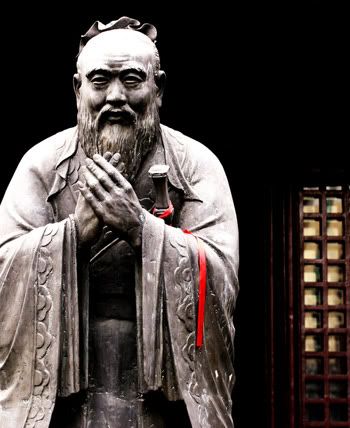
The writings of Confucius give a great deal of import to filial piety, or xiao, a moral imperative to worship one's ancestors and to honor one's parents. Even still, filial piety is the first precept of Chinese culture, extending from the family and into one's public life. The crux of filial piety is to show respect for one's elders, to know one's place in society, and to honor the family.

Throughout history, the Chinese have held great respect for the older generation. With age comes wisdom and experience. Knowledge gleaned over the years can be passed down to the younger generations, granting them better insight. To show honor and respect to one's elders is to acknowledge the important place the older generation has in society, something that is easily dismissed in the western world. The aged have little to no place in the modern world as their knowledge appears outdated or limited. This belies the importance the western world places on technology. There are other lessons to be learned. Just because someone does not know how to use a computer doesn't mean that their import is useless. Sadly, as China becomes more and more modernized, I fear this admiration for the older generation will fall to the wayside.

Filial piety also means to know one's place in society. This begins with one's place in the family. The father is the head of the household. The mother is his consort. The sons and daughters are ranked as well according to age and gender. This family hierarchy predated Confucius by thousands of years. The I Ching, or Classic Book of Changes, compares the household to the ba gua, or eight trigrams sometimes referred to as the octagon. Each trigram represents a direction, a natural phenomenon, an element, as well as a family member among other meanings. They are:

Heaven - the father - control - metal
Earth - the mother - patience
Thunder - the eldest son - action - wood
Wind - the eldest daughter - communication - wood
Water - the middle son - instinct
Fire - the middle daughter - intellect
Mountain - the youngest son - introspection - earth
Lake - the youngest daughter - imagination - metal

According to feng shui, each member of the household should be assigned a particular portion of the domicile as determined by several factors as the location the house faces, the age of the house, etc. Each portion of the house, known as the nine palaces, supports the most outstanding traits of that family member.

The Father - Spirituality - usually a household shrine
The Mother - Love - the master bedroom
The Eldest Son - Family - a family meeting place, typically the kitchen
The Eldest Daughter - Prosperity - a room containing art and treasures, usually heirlooms, or a dowery
The Middle Son - Work - an area in which to conduct business, like a study or shop
The Middle Daughter - Fame - a place to advertise trophies, certificates, and other honors bestowed upon the family
The Youngest Son - Knowledge - a library or study
The Youngest Daughter - Creativity - the children's bedroom

One's place in the household may very well dictate one's place in society. This was true in the western world as well. The eldest son would often seek a military career, the middle son would go to university, and the youngest son would join the clergy. This is evident in much Russian literature. In China, your station is not just in the family, but at work and in society in general. Knowing your place is integral in maintaining social order. To overstep your place, or to undermine or misrepresent your place brings dishonor.

Which brings us to the last topic regarding filial piety. Care must be taken to honor the ancestors and the family name. Above all, one must show honor and respect to one's parents. Sacrifices must be made to honor the ancestors, one's parents should be cared for as they age, one must behave oneself as to not dishonor the family name, one must also counsel one's parents so they, too, do not bring dishonor. Finally, the proper grief should be exhibited at the passing of one's parents.

Filial piety may be a central concern for many Chinese, but not all. Daoists often follow their own paths and, though not flagrantly acting with disregard to these imperatives, nevertheless do not follow them as strictly. There is an account in the Chuang Tzu, a Daoist text, that tells the story of Lao Tzu, the founder of Daoism, after the death of his wife. Friends of the family come to offer him consolation, but find him in the yard hopping about like a sparrow. Concerned tat he has either lost his mind through grief, or worse, is not showing the proper respect, they approach and confront him. In response he says that he loved his wife dearly. He feels no grief as her death was only natural. Furthermore, he felt no sorrow as she lived, so why feel sorrow at her death?

Daoists are often misunderstood. Another example, I believe from the Wen Tsu text, is of a Daosit sage encountering a funeral procession on a hill. The tomb is a massive and elaborate construct. The sage inquires as to the nature of these goings on. Someone informs him that a great man has died. The sage replies that were he truly that great, no one would have shown up and the grave would be far less conspicuous. This accounts for the Daoist regard for non-action, or rather, non-involvement. Much harm is done when one sticks his nose where it does not belong. Better to let things run their natural course than to shape the world as you see fit.

The western world has its own kind of filial piety. Judaism and Christianity refer to the Ten Commandments, one of which is to honor thy father and thy mother. However, for the most part, western society promotes rebellion. It is in going against the values of the previous generation that the new generation defines itself. The veteran generation is all about hard work, dedication, and self sacrifice. Baby Boomers rejected the traditional values of their parents and established a counter-cultural revolution, yet, ironically, have been known for their rate of consumption. Boomers often identify themselves by how much they own, a trait that flies in the face of those that grew up during the depression. The X generation is known for its lack of values. There is no one hero that all can grasp. Furthermore, they seem wary of authority figures. X-gen people identify themselves through '80s television, music, and other media. X-gens are fiercely independent, preferring to work alone and at their own pace. Millennials, or generation next, is less jaded than their forebears. They have an innate talent for technology, having been born in the digital age. Millennials prefer working together as social networking and cooperation is something they have grown up doing.

So, western society develops from rebellion. Eastern society maintains order through tradition.

Saturday, September 5, 2009

Classical Psychology


During the Renaissance, it was generally believed that our mood was controlled by humours, or fluids, within the body. This is where the term "humor" originated. There were four humors. I will define each humor and its related mood.

Bile or Bilious
Bile is created in the spleen, so this mood is also referred to as splenetic. An excess of bile results in feelings of anger and aggression. The terms sour and hot-headed spring to mind. Those of a bilious nature are argumentative and prone to violent outbursts and even violent acts.

Black Bile or Melancholic
An excess of black bile leads to feelings of sadness and depression. The melancholic person is prone to weeping and despair.

Phlegm or Phlegmatic
An excess of phlegm denotes feelings of apathy and discontent. The phlegmatic person is likely listless and uncooperative. The terms lazy and uncaring fit the bill.

Blood or Sanguine
Excited blood is a sign of passion, which may be sexual, or joyful, or loving, or prideful. The sanguine person is excitable, optimistic, manic.

More recently, these four humors were graphed to represent levels of stability and social outwardness, like so.

STABLE
Phlegmatic | Sanguine
|
INTROVERT -----NORMAL-----EXTROVERT
|
Melancholic | Bilious
UNSTABLE

As you can see by the graph, the phlegmatic personality is that of a stable introvert, while the opposing personality, bilious, is that of an unstable extrovert. Likewise, the sanguine personality is that of a stable extrovert, as the melancholic sort is an unstable introvert.

Extroverts are open in public. They experience validation in receiving attention. They prefer not to be alone as contact with other people is something they crave. Loneliness is somewhat of a curse as these types are social animals. Extroverts often view the world objectively, with clear ideas of right and wrong.

Contrarily, the introvert has a dislike for calling attention to himself. the introvert prefers to be alone as crowds often sap their inner reserves. Introverts are subjective, knowing that each person's world view is unique and that there is no clear right and wrong.

Stability refers to how functional one is in society. A sanguine person, then, is a functional public person, while the phlegmatic person is just as functional, but more reserved. Typically, the western world prefers the sanguine personality, the boisterous character, the swagger, the joy-de-vive. However, the eastern world prefers the phlegmatic type, the pensive nature, the philosophical attitude, the meditative qualities. As such, each hemisphere has a profound distaste for the opposing personality. The western world typically dislikes a melancholic personality. This may be why emo and goths end up the punch line of a joke, or suffer bullying. This is also why depression is often misunderstood or misrepresented or feared. Even the slightest indication that a child feels sadness may cause the parents to rush to the nearest pharmacist for anti-depressants. On the other hand, the eastern hemisphere finds public, angry outbursts dishonorable. Those that cannot keep a cool head are found to be unwise, and lose face. Where the control of one's emotions is key, to lose one's temper is not acceptable.

Most people vacillate between all four personalities, but rarely to any extreme. True normalcy, if there is such a thing, lies in the crux between the various poles. This is the center, where the humours are in perfect harmony. This is stoicism at its finest.

In regards to the fifth installment of The InsideOutcast, comedy appeals to our more sanguine nature. This is where the term "sense of humor" originated. Those that do not have a good sense of humor, then, must be one of the other personality types. It is difficult to laugh when depressed because the humors are opposed. It is difficult to laugh while feeling apathetic. It is also difficult to feel joy if angered. The four personalities do not mix well.

So, whatever your leanings, I hope this garners you some insight into the various emotional states. To understand oneself, I find, is to better understand others. Perhaps knowledge of the humours may provide some insight into conflicts of personality. To understand a problem is often the first step to overcoming it.

Be well.