
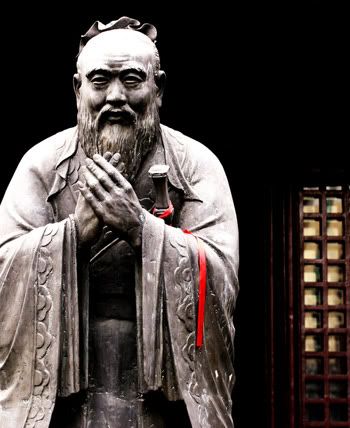
 The writings of Confucius give a great deal of import to filial piety, or xiao, a moral imperative to worship one's ancestors and to honor one's parents. Even still, filial piety is the first precept of Chinese culture, extending from the family and into one's public life. The crux of filial piety is to show respect for one's elders, to know one's place in society, and to honor the family.
Throughout history, the Chinese have held great respect for the older generation. With age comes wisdom and experience. Knowledge gleaned over the years can be passed down to the younger generations, granting them better insight. To show honor and respect to one's elders is to acknowledge the important place the older generation has in society, something that is easily dismissed in the western world. The aged have little to no place in the modern world as their knowledge appears outdated or limited. This belies the importance the western world places on technology. There are other lessons to be learned. Just because someone does not know how to use a computer doesn't mean that their import is useless. Sadly, as China becomes more and more modernized, I fear this admiration for the older generation will fall to the wayside.
Filial piety also means to know one's place in society. This begins with one's place in the family. The father is the head of the household. The mother is his consort. The sons and daughters are ranked as well according to age and gender. This family hierarchy predated Confucius by thousands of years. The I Ching, or Classic Book of Changes, compares the household to the ba gua, or eight trigrams sometimes referred to as the octagon. Each trigram represents a direction, a natural phenomenon, an element, as well as a family member among other meanings. They are:
Heaven - the father - control - metal
Earth - the mother - patience
Thunder - the eldest son - action - wood
Wind - the eldest daughter - communication - wood
Water - the middle son - instinct
Fire - the middle daughter - intellect
Mountain - the youngest son - introspection - earth
Lake - the youngest daughter - imagination - metal
According to feng shui, each member of the household should be assigned a particular portion of the domicile as determined by several factors as the location the house faces, the age of the house, etc. Each portion of the house, known as the nine palaces, supports the most outstanding traits of that family member.
The Father - Spirituality - usually a household shrine
The Mother - Love - the master bedroom
The Eldest Son - Family - a family meeting place, typically the kitchen
The Eldest Daughter - Prosperity - a room containing art and treasures, usually heirlooms, or a dowery
The Middle Son - Work - an area in which to conduct business, like a study or shop
The Middle Daughter - Fame - a place to advertise trophies, certificates, and other honors bestowed upon the family
The Youngest Son - Knowledge - a library or study
The Youngest Daughter - Creativity - the children's bedroom
One's place in the household may very well dictate one's place in society. This was true in the western world as well. The eldest son would often seek a military career, the middle son would go to university, and the youngest son would join the clergy. This is evident in much Russian literature. In China, your station is not just in the family, but at work and in society in general. Knowing your place is integral in maintaining social order. To overstep your place, or to undermine or misrepresent your place brings dishonor.
Which brings us to the last topic regarding filial piety. Care must be taken to honor the ancestors and the family name. Above all, one must show honor and respect to one's parents. Sacrifices must be made to honor the ancestors, one's parents should be cared for as they age, one must behave oneself as to not dishonor the family name, one must also counsel one's parents so they, too, do not bring dishonor. Finally, the proper grief should be exhibited at the passing of one's parents.
Filial piety may be a central concern for many Chinese, but not all. Daoists often follow their own paths and, though not flagrantly acting with disregard to these imperatives, nevertheless do not follow them as strictly. There is an account in the Chuang Tzu, a Daoist text, that tells the story of Lao Tzu, the founder of Daoism, after the death of his wife. Friends of the family come to offer him consolation, but find him in the yard hopping about like a sparrow. Concerned tat he has either lost his mind through grief, or worse, is not showing the proper respect, they approach and confront him. In response he says that he loved his wife dearly. He feels no grief as her death was only natural. Furthermore, he felt no sorrow as she lived, so why feel sorrow at her death?
Daoists are often misunderstood. Another example, I believe from the Wen Tsu text, is of a Daosit sage encountering a funeral procession on a hill. The tomb is a massive and elaborate construct. The sage inquires as to the nature of these goings on. Someone informs him that a great man has died. The sage replies that were he truly that great, no one would have shown up and the grave would be far less conspicuous. This accounts for the Daoist regard for non-action, or rather, non-involvement. Much harm is done when one sticks his nose where it does not belong. Better to let things run their natural course than to shape the world as you see fit.
The western world has its own kind of filial piety. Judaism and Christianity refer to the Ten Commandments, one of which is to honor thy father and thy mother. However, for the most part, western society promotes rebellion. It is in going against the values of the previous generation that the new generation defines itself. The veteran generation is all about hard work, dedication, and self sacrifice. Baby Boomers rejected the traditional values of their parents and established a counter-cultural revolution, yet, ironically, have been known for their rate of consumption. Boomers often identify themselves by how much they own, a trait that flies in the face of those that grew up during the depression. The X generation is known for its lack of values. There is no one hero that all can grasp. Furthermore, they seem wary of authority figures. X-gen people identify themselves through '80s television, music, and other media. X-gens are fiercely independent, preferring to work alone and at their own pace. Millennials, or generation next, is less jaded than their forebears. They have an innate talent for technology, having been born in the digital age. Millennials prefer working together as social networking and cooperation is something they have grown up doing.
So, western society develops from rebellion. Eastern society maintains order through tradition.


No comments:
Post a Comment