Showing posts with label Science-Fiction and Fantasy. Show all posts

Sunday, June 19, 2011

The Green Lantern and the Monomyth

That a superhero movie follows the monomyth is no great surprise. The interest is in how each movie treats the hero's path. The new Green Lantern movie features many of the signature elements of the hero's journey. The treatment ranges from the cliched to the surprising.

First and foremost is the apotheosis of the father. Hal Jordan is the son of a fearless test pilot. As such he must live up to those expectations. He walks in the footsteps of his father, yet never feels he is adequate. Irresponsibility stems from doubt. Since he inwardly feels unworthy he, whether consciously or unconsciously, sets himself up to fail. The culmination of these fears occurs in his stalled descent in a fighter jet. Hal misses the opportunity to control his plummeting plane because he relives the moment of his father's death. Frankly this could have been played out more efficiently. With Top Gun and the parody Hot Shots, this scenario has the mark of cliche.

The we have the encounter with the gods and the call to adventure, these two scenarios being inexorably linked in Green Lantern. With the crash and imminent death of Abin Sur, Hal Jordan is selected by the ring and brought to the injured alien. Despite the information overload of being whisked through the air and confronted by an alien spacecraft, Hal shrugs off this disorientation when he spots the injured Abin Sur. This is one of the first of the tests and trials Hal faces in order to prove his worth as a hero.

Abin Sur, as messenger of the gods, offers Hal the power of the ring. The ring here represents the magical weapon, the gift of the gods imbued with the power to fight evil provided the hero is worthy. The lightsaber from Star Wars is such a weapon as is Thor's hammer. But with the power of the ring comes the responsibility of using it wisely. Hal, who has shown up to this point a knack for irresponsible behavior, must overcome his past self to become the hero of destiny.

The call to and refusal of adventure is treated somewhat differently in Green Lantern. At first Hal is eager to accept the call. He swears an oath must further prove his mettle in the underworld, here represented by the planet, Oa. Oa is home for the Green Lantern corps. It is the source of their power. In a mythic sense it equates to Mount Olympus or Asgard. Oa houses the gods. Journeying to Oa, Hal Jordan is first prepared in a baptism of pain. His body is made pure that he may interact with the gods, i.e. the other Green Lanterns. As he explores more and more of Oa, he encounters creatures stranger than the next. Now Hal is a visitor between worlds. His gift removes him from humanity and his humanity separates him from the aliens on Oa. At this time he is the most alone and the most vulnerable.

He is aided by two aliens, other messengers of the gods, who provide him with tests of skill regarding the mind and the body. It is Sinestro, though, who tests Hal's spirit. Sinestro, played by Mark Strong, enters as Hal's rival, filling a role for a bother battle. Hal must match or surpass Sinestro in skill to be found worthy. That Hal fails in this test is the seed of his decline. He rejects the call to adventure and returns to the Earthly realm as a quitter.

It is only when his own realm is threatened that Hal reclaims his charge. All this while evil has taken root on Earth in the form of Hector. A wayward scientist, Hector is infected with evil. It claims his mind, body, and soul. Hector is Hal's shadow. They love the same women. Both have father issues. Each is crippled by self doubt. While Hector is corrupted by his feelings, Hal acknowledges and controls them. He returns to Oa only to be refused assistance. The gods turn their back on him. He confronts the gods, and Sinestro, and oversteps his place.

Hal battles evil on his own, knowing that he is outgunned. He is fully actualized. He uses the skills he has learned along the way, as well as the magic weapon, to defeat evil. In his moment of self sacrifice the gods accept him and rescue him from death.

There are several other elements at work here as well, but that is the gist of the monomyth. It's pretty straight forward. This may, in part, be the source of much outcry against this film. Much seems familiar. Some have remarked that Green Lantern is just The Last Starfighter, failing to grasp that they share the same mythic elements, not the same story and characters. However, other films have been more effective in telling the story. While the script is not as sparkling as Thor or X-Men: First Class, it is a far sight better than the new Star Trek or Tron: Legacy. In short it falls somewhere between, sharing a spot with Iron Man 2. The principle actors surpass the script to deliver a movie that is much better than it could be.


Friday, January 14, 2011

TRON! Legacy?

When Legacy came out I knew we had to see it. I had reservations. I expected very little, but being Disney and being TRON I at least expected it to be fun. It wasn't. It is not uncommon that I may sigh or roll my eyes at a film. Something can be ridiculous, yet still enjoyable. It is rare that I actually sneer at a film.

Why sneer? Because I hold something in contempt. Because the film insults my intelligence. Because I see past the spoken word to see the poorly written script seeping through. There are many reasons to deride the film. Granted I hated Legacy less than Transformers 2 or Armageddon, but far more than Twilight. I hold it about even with the Star Trek reboot. Thinking about it, both movies are a kind of re-imagining for a new and younger audience. Story and structure is less important than pretty people and shiny special effects.

I had my doubts when TRON Legacy opened with a number of TRON action figures on a boy's shelf. Hang on a tick. Did Flynn come out with his adventures? Did he market his story to Disney? Is everyone aware of his misadventures in the system or did he fictionalize his account? I was confused and a little dismayed. Flynn tells the story of TRON to his son, then disappears. This is where the film lost me. A montage of TV news reports informs us of the events that take place after Flynn's disappearance. Besides being a clumsy way to present exposition, the clips take place on TV screens in some nebulous space. Where are these televisions? Are they in the system that, as far as I know, has no connection to the web? It's a poor choice by the film makers that took me out of the film completely.

Then we meet our hero in earnest, a rebellious, tech savvy, twenty-something with more hair gel than soul. We have seen the archetype of the angsty heir before and we've seen it better. Sam cannot compare to Bruce Wayne or Tony Stark. So Sam breaks into the Encom building after recklessly driving his motorcycle and avoiding cops. In this sequence we see the amazing Cillian Murphy which lifted my hopes only to dash them. Murphy is just a cameo, when his presence as a villain or foil would have added considerable gravitas to the film. Sam hacks into Encom's system and makes the new OS they worked on open source.

We discover later that Sam is the major share holder and could have avoided flagrant lawbreaking just by attending the meeting. And what's with Encom? The offices are bathed in an electric blue light with chrome and glass everywhere. What happened to the natural wood? The warm, subdued lighting? The system breathes with more life than Encom which only narrows the distinction between these two worlds.

When our reluctant hero finally enters the system we find that he really isn't all that heroic at all. Constantly he is being saved, or lead, or captured. Everything Sam does is passive. Things happen to him. He doesn't really do anything for most of the film. The rare exercise of will does not contribute to the story. Sam is bland and has no chemistry with his father.

And the system itself is a far cry from the TRON we know from 1982. The world of the system then had charm, with it's minimal graphics. It looked like an electronic world. The system of TRON Legacy is hyper real. It looks more like a futuristic society than an electronic dimension. The grid of old has been replaced by what looks like granite or asphalt. The shimmering, latex suits of old appear to be more natural fabrics now. It rains. Moreover, the world seems to be populated by supermodels and EBM band members. The whole experience is more style than substance.

The action itself is highly stylized. Programs don't just throw disks, they have to do some kind of extreme martial arts 900 spinning backflip before doing so. Somehow the modernized representation lacks the charm of TRON 1982. The light cycle sequence, though beautiful, doesn't follow the sharp 90 degree turns of the original film. The sense of a video game world is lost.

And then there is CLU. We see a digitally younger Jeff Daniels. CLU has the same surfer-dude mannerisms of Flynn, yet has this fascist perspective. The lazy posture and the rigid attitude conflict in such a way that I have difficulty fusing the two.

The story is convoluted and mostly involves flashbacks. Flynn creates CLU. They discover the spontaneously generated programs. CLU destroys them. TRON gets reprogrammed. And what is with TRON? How can you in good conscience call a film after a character that features mostly as a foil. And when TRON finally breaks from his spell there is absolutely no consequence. For the most part Legacy follows the basic action of the first movie. Man gets zapped into the system. He has to play games. He escapes. He makes his way back to the portal to get back to the real world. Legacy features a few more action sequences, namely the entirely unnecessary club scene. The added action doesn't move the story, making Legacy the equivalent of The Matrix: Reloaded. Nevertheless, there remains the dull dinner sequence and the light boat scenes that dragged much like the scene by the pond in TRON.

Much has been said regarding the soundtrack by Daft Punk. I felt the music too much in the foreground, the aforementioned club scene being just one account. The music is good, but distracting or, rather, too on the nose. It's presence turns the film into an extended music video. There were many options for electronic artists. I'm left wondering what a Bill Leeb or a Gary Numan may have done with the same opportunity.

TRON Legacy was a film that needn't have been made. Disney showed some speculative shots of light cycles during a technology demonstration. When they heard the response the executive saw with dollar signs for eyes. But in the end, Sam fails. He does not return with his father, suggesting a third movie. I'm not invested enough in this franchise to want a third film. TRON did not warrant a sequel in the first place.

If I were Flynn and nearly died in a computer system would I willingly go back? They have mice and keyboards for a reason, you know.


Thursday, July 1, 2010

Iron Man vs. Iron Curtain

Stan Lee created Iron Man during a turbulent time in America. 1963 saw an emerging culture war between conservatives and radicals. The civil rights movement was building as the stage was set for the Vietnam War. With the help of writer, Larry Lieber and artists Jack Kirby and Don Heck, Stan Lee created a character that defied everything the youth movement aimed for. Lee took it as a challenge to see if you could design a hateful character and still make it a success.

Tony Stark embodied everything young America stood against. He was made to be a cold war icon, America's defense against the Soviet Union.

A wealthy industrialist, Tony was a far cry from the bohemian artists, beatniks, and flower people of this era. Tony is very much the capitalist. He buys and sells things. Manufacturing those things is his role in life. This includes everything that comes with capitalism. Supply and demand. Advertising. Competition. Buy outs. Investment. During a generation that turned a wary eye towards wealth, Tony's excesses were just that, excessive.

Moreover, Tony Stark is a hawk. He is pro war. He designs and sells weapons to countries, weapons with the very specific goal of eliminating life. These weapons are aimed primarily at socialists that threaten the free market system Tony represents. In short, Iron Man employs capitalism to defeat socialism.

Ayn Rand keeps making her appearance in this blog. Tony Stark is not that far off from a Gail Wynand or Roark type of character. Tony Stark is a self mover. He is self sufficient. An inventor, he designs the product he sells. He is creator and salesperson in one. He is Stark Industries. Furthermore, he is the epitome of narcissism. Most heros keep their real identity secret. Not Tony Stark. Not content with passing by the publicity and the acclaim, he admits to being Iron Man. The two are synonymous. Based loosely on Howard Hughs, Tony Stark has his eccentricities. He has also had many loves. Indiscriminate sex is just how he rolls.

Despite what appears to be a checklist of things young people hate, Iron Man had gained considerable popularity. As far as superheros, he has received the most female fan letters. Self confidence, intelligence, and wealth speak volumes when it comes to attracting the ladies. But that is not all. Consider his injury, a wounded heart. The metaphor is clear. Here is a great, yet vulnerable man. The technology he builds to protect the world also serves to keep him alive.

However, Tony's rather unique independence caused concern over the years. He founded the illuminati, a society of superheros originally formed to make the various heros answer for their actions. Ironically, Iron Man also went on a rampage, destroying everything based on his tech, including the S.H.I.E.L.D. Mandroids. Furthermore, Tony Stark pushed for the reinstatement of the registration act that led to the Marvel civil war.

Tony is quite the conundrum, having been the head of The Avengers, having been an inquisitor, having been a drunk, having been a soldier for peace. Yet, basic elements of the character remain throughout. At the root of it all he is a playboy industrialist in a shiny, armored suit.

Friday, June 4, 2010

Telephoto vs. Wide Angle

There are two ways to perceive the world we live in. One can take a very narrow, yet focused look - a look of pinpoint precision. On the other hand, one can step back and look to the horizon, taking in a glorious panorama. These methods of observation are closely related to photography, namely the use of the telephoto and wide angle lenses.

THE TELEPHOTO LENS
In the TV show, Bones, Agent Booth refers to them as squints. They are scientists that look closely at an object. Experts are experts for a reason. Simply stated, they know what they are looking at. They notice the finer details. Why is the remains that of a woman? Notice the aspect ratio of the pelvis. Notice the structure of the skull. Where some see only a skeleton, an expert sees the remains of a Chinese woman with an iron deficiency.

By limiting our scope, we can narrow our focus like a laser. This relates to personal tastes as well. Imagine the Trekkie or Trekker. Star Wars may be okay, but it doesn't really interest them. They live for Star Trek. They know each line, each episode title, each gaff, each set piece, each inconsistency. Music fans, too, may hone their senses to a more narrow genre of music. Look at the thrash metal fan, the gothic rocker, the American hardcore punk.

The benefits of a telephoto perception is that one knows an awful lot about a particular subject. The person is a specialist of sorts. The liabilities are that knowledge of other topics must be shoved aside. Time and effort that could be used to appreciate other things is not to be wasted. That time, that effort are devoted to the subject at hand, the main topic if you will.

THE WIDE ANGLE
If you want to capture the whole image that you see before you then use a wide angle lens. The wide angle perspective steps away from the individual subject to see how it relates to the whole. How does Star Trek relate to science-fiction as a whole? How does the death of this person relate to the investigation of this crime? How has thrash metal evolved from its roots in Black Sabbath and Led Zeppelin?

This person takes in a wide assortment of information, but a lot of it is quite generic. When stepping away from the subject, some of the finer details are lost. We forget actors' names, we forget episode titles, we forget the sequence of events. We deal in the basics, the fundamentals, the outlines. As such, one becomes, as they say, a Jack of all trades and master of none. There is no expertise, only a broad collection of common knowledge.

The two systems of thought stem from the taxonomy of perception. Just as in the classification of animals, the classification of ideas attributes to the generic and the specific. Generic knowledge is the wide angle. Meanwhile, the telephoto approach is more specific. Neither is more or less valid than the other. Indeed, the two must work in tandem. Otherwise knowledge fails to serve. Specifics have no use unless applied to a general construct. What has the weight of the cadmium atom to me? Now, add the battery cell and its relationship to the world is more clear. Meanwhile, generals mean little without specifics. What is a battery without the specifics of the chemicals involved?

The telephoto/wide angle pairing appears in other forms. For instance, in the martial arts aggressive styles often take a telephoto approach. There exists a tunnel-vision like focus upon one enemy. Attacks are linear and direct. Meanwhile, defensive styles take a wide angle view. The person is aware of attacks from all sides.

Usually we are able to slip from one perspective to another, but in some things we may be locked into a certain perspective. Perhaps we fail to see the finer details of a situation. This could be in relationships, at work, or in art. At other times we may fail to see past the finer details and thus lose out on the overall theme.

Saturday, February 13, 2010

Jungian Pooh

As promised, I present the personalities of the characters in A.A. Milne's classic, Winnie the Pooh. I am not the first to compare the inhabitants of the 100 Acre Wood with modern personality types. The Tao of Pooh and The Te of Piglet by Benjamin Hoff does this quite well. This is not a stretch, however. Clearly each animal is meant to represent some Jungian archetype. Here I shall list the character, his or her traits, and the modern equivalent.

Eeyore
The blue donkey known as Eeyore is blue for a reason. Eeyore is the epitome of apathy, dispassion, listlessness, and depression. The somber Eeyore is a pessimist. He lives in a simple shelter of a number of piled together sticks. Why? Because that is the best he can hope to get. He falls in a stream and floats and floats, never struggling to make his way to the bank. He waits for someone to help him out - just as long as it is no bother. His unwillingness to provide for himself coupled with the passive-aggressive manner are the main traits of this mournful quadraped. Nevertheless, many of us love Eeyore dearly. Why? Because the little Donkey that couldn't appeals to our own melancholy.

Learned helplessness is the psychological basis behind apathy. Repeated failure leads to no longer trying. If a dog is placed on an electrified floor and has no means of escape, it has little choice but to lament the situation. Repeated experiences in this electrified room conditions the dog to this state of being. One day, when a partition is removed to allow the canine and escape from discomfort, the dog does not take the opportunity. Experience has proven that escape is impossible. Why should this time be any different.

So it is with man. Repeated failure conditions us to anticipate failure. Like Eeyore, we do not strive as hard as we should. We do not swim for the bank of the river. When we accept failure as the only outcome, an attempt to change the situation seems futile. Why bother? As such, many of us remain in a less than desirable position simply because no other option presents itself - or so we think. The pessimist does not bother hoping for the best, let alone taking action to improve things.

That is not to say the Eeyore personality is joyless. The pessimist can find value in the small things, in consistency and routine. Even isolation can provide solace for the blue. Eeyore does not seek to be with his friends. If they come by, fine. So much for misery loving company.

Gopher
Gopher is not a very popular character. The blind, gruffy rodent is an industrious sort. He is known to be digging his tunnels into which other characters occasionally fall. Gopher did not appear in the storybook. he is an invention of Disney, based primarily on the beaver from Lady and the Tramp. Gopher typically whistles through his teeth as he speaks. He also has very poor eyesight.

Gopher represents the older generation, primarily the veteran generation. Those that experienced WWII and/or lived through the great depression have a strong work ethic. They are stern, no nonsense people with a strong moral center. It is clear that gopher is meant to be older. Furthermore, Gopher spends most of his life underground. Much like older generations hole up in their homes, are wary of new technology and recent trends, and the like - Gopher's existence underground and in the dark is more literal than symbolic.

Despite unfamiliarity with current trends, the older generation has experience. Gopher's experience often comes in useful. Wisdom, too, is an asset of the older generation. Gopher embraces this dichotomy of wisdom and experience and contemporary ineptitude and conditions of age.

Kanga
Kanga is the only female character in the storybooks. As mother to Roo, she embraces the aspects of motherhood and femininity. She is affectionate and protective. Though not very educated, she is naturally inclined to do the best for her son and by extension her friends. Later, she welcomes Roo's friend, Tigger, into their home.

Clearly Kanga is the archetypical woman, combining elements of the Empress and the Priestess from the tarot. In one respect, she is mother and protector. The matron of 100 Acre Wood, Kanga is the primary caregiver. Meanwhile, she incorporates women's intuition, that knowing without knowing. She knows when there is trouble, when her son is in danger. She also knows when someone is playing a joke on her.

Owl
Owl is a bespectacled bird living in a stately home high up in a tree. Owl is educated, or so he thinks. He is able to read and write, almost. He is quick to advice, instruction, and anecdotes regarding distant family members. Owl explicitly embodies the archetype of the educator. He is an academic.

Academia is under the illusion that it is providing young minds with the assets necessary in surviving the work a day world. However, real life is often worlds apart from the class room. The teacher is often removed from reality, living in an ivory tower of textbooks and chemistry sets. That is not all. A little knowledge is a dangerous thing. Armed with half the facts, the academic is prone to fill in the blanks with supposition. That owl assumes Piglets home is his own is such a leap to conclusions.

Owl is quick to state some meaningless fact, which typically is false or only half true. I, too, find that I offer facts, opinions, advice, etc. a little too freely. There is something owl like in my manner. Even this blog has the mark of the owl. A bit preachy, a bit self-aggrandizing, a bit pedantic.

Piglet
Piglet is Pooh Bear's very best friend. He is very small and knows this to be true. His small stature makes him timid and meek. He is fearful, even of his own shadow. Yet, he has a big heart.

The funny thing about those of a nervous disposition, those that jump at shadows, is that when a real crises presents itself, often they overcome fear. It is as though the truly frightening is beyond their capacity. Those that jump at the shadow of a beast when confronted with a beast do not jump. In the Te of Piglet, Hoff expounds on the virtues of the small, the integrity of piglet. He is righteous in a nonjudgmental fashion, he is brave when courage is required, he is loyal when friends are troubled.

Piglet has many qualities I admire, and by extension those qualities I find in people. Humility, compassion, caution, loyalty. These traits make up a good friend.

Rabbit
As discussed in the podcast, Rabbit is the least liked of the inhabitants of 100 Acre Wood. Rabbit can be summed up in one word, stress. He places an exorbitant importance on things. He guards his garden from Tigger and Gopher. He protects his honey from Pooh. We fails to grasp the concept of sharing, the enjoyment to be had by giving to friends. Simply, he cannot let go.

We are familiar with the type, the workaholics, the micromanagers. Those who place too much importance on things, on routines, on the destination and not the journey will only find dismay. The four noble truths of Buddhism state that 1) life is suffering and that 2) suffering comes from attachment. Attachment is the process of identifying ourselves with objects, in a sense actual objects of desire. Cars, yachts, houses, clothing, electronics, anything that can be consumed. These are fragile things with no real value outside that we attach to it. By strapping our sense of self to these objects, our ego, too, is just as fragile and hollow.

The Rabbit personality claims to own things, but they really own him. Consider how much time he spends in his garden. If he only knew that gardens naturally grow.

Roo
The sun of Kanga, Roo is the embodiment of child like innocence. A friend of Tigger and Piglet, Roo is playful, with that spirit of adventure that most boys have. He balances Piglet, as he draws the gentle pig out of his comfort zone. He balances Tigger as, though found of activity, Roo is more responsible.

Back to the tarot, the first card, the 0 card, is The Fool. The Fool represents child like innocence and that sense of adventure. The Fool is fearless, as all young boys tend to be. Death cannot touch him. The Fool is an optimist as well, with eyes fixed on the distant horizon and not the dangerous precipice before him. Roo, and children like Roo, carry this spirit in their hearts. Some maintain this adventurous spirit into adulthood, becoming test pilots, explorers, astronauts.

Tigger
Nearly everyone's favorite character, usually with the exception of Pooh, is Tigger. Tigger is bold, brash, exuberant, friendly, outgoing. He embodies those traits that make one popular. He seems entertaining, certainly fun at parties. And Tigger means well. There is no question that he appreciates having friends. He is the very epitome of the extrovert.

However, there is a down side to Tigger. Consider if you would like Tigger as much if he were real and an actual friend. Where ever he goes, he leaves a trail of destruction like a tornado. He is a whirlwind of activity. One is reminded of either someone with Attention Deficit Disorder or a major sugar high (or some other stimulant). Life with a Tigger personality, though exciting, is also exhausting. Tigger types love life, and seek to squeeze every drop of enjoyment from life. Sadly, this often leaves everyone around them drained.

Tigger types, though lovable, are best experienced in small doses.

Winnie the Pooh
The bear of very simple brain, Winnie the Pooh, is a strange archetype for a hero. He is absolutely without guile. If he comes to your house, he willingly admits that he has come for a jar of honey. True, he may engage in some pleasant conversation as well, but his motives are there on the table. He is by no means a thinker, he is not even that much of a doer. He just is.

In the Tao of Pooh, Hoff compares these qualities with those of the Daoist sage. The goal of Daoist path is to return to simplicity. When your only concerns are food and sleep, then you have stripped away all the extraneous detritus from your life and are just that closer to wuji - the state of formlessness comparable to nirvana.

Pooh is what he is. Sadly this is looked down upon in our society. A lack of ambition is viewed as laziness. Honestly is regarded as crude and blunt. Simplicity in speech and manner is deemed unsophisticated to downright stupid.

Yet Pooh Bear forms the hub of this circle of friends. Each knows what they may expect of Pooh. Pooh has no hidden agenda. Even Rabbit tolerates Pooh to some degree, setting aside a few jars of honey for when the gentle bear drops by.

So, there you have it. The personalities of the characters devised by A.A. Milne as compared to our own personality archetypes. Which are you? Well, I think each, even Rabbit, reside in our hearts. That we feel a certain way about each reflects on how we view those separate elements of our psyche. That I find my knack for pedantry an embarrassment, yet regard my timidity with less disdain directly correlates with how I view Owl and Piglet.

Saturday, January 30, 2010

Social Capital

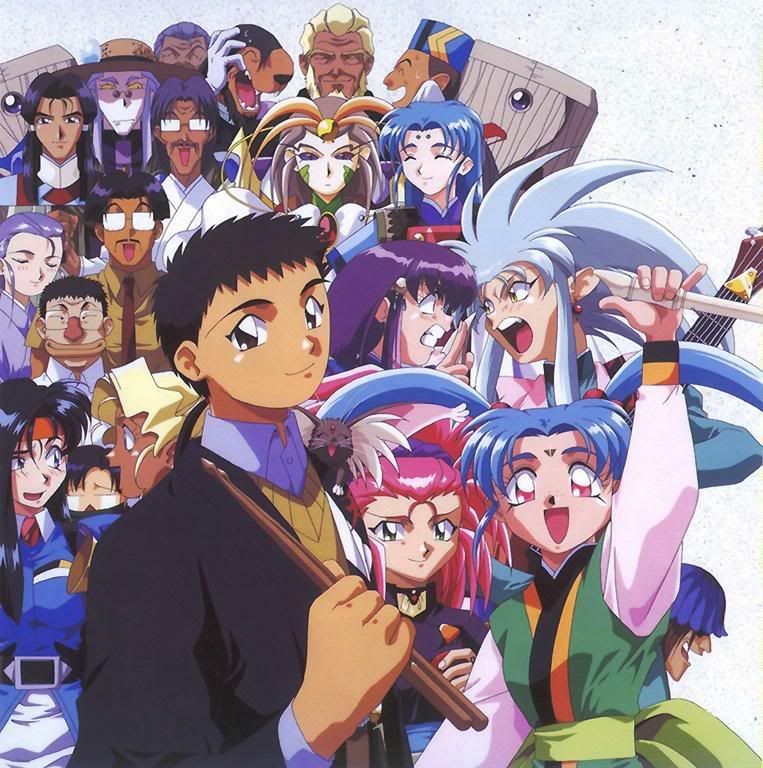
In our discussion of the Tenchi anime series, I mentioned how Tenchi formed the center of a web of different social groups. I compared this to twitter, other online social networks, and the more immediate connections we have with friends and family. Tenchi's first contact is his family. His father and grandfather - even his deceased mother - are his closest ties. Next is work and school - his obligations as a student and as a priest in training. After this, his connection with the various alien women that occupy his home.

Ryoko represents the wild side. A space pirate, she is bold, brash, immodest, crude. Mihoshi represents inexperience. A junior police officer, she is quick to emotions of happiness and sorrow. Ayeka represents tradition and high society. The first Princess of Jurai, she is wealthy, cultured, and haughty. Sasami represents childlike innocence. The second Princess of Jurai, she is honest, helpful, and without guile. Washu represents knowledge and skill. A renowned scientist, she is educated, curious, and inventive. Kiyone represents responsibility. A career police woman, she is meticulous, cautious, and frustrated.

Tenchi's relationship with each girl directly influences them in some way. Ryoko, usually very masculine in behavior, appears more feminine and vulnerable in his presence. Ayeka, normally of a composed demeanor, slips into fits of shameless infatuation and jealousy. The connection is stronger in some relationships than others, but each relationship affects both Tenchi and the girl in question to some degree. Furthermore, each girl influences not only Tenchi, but the other girls as well. Ayeka compares herself to Ryoko, thus confirming her social status. The Washu to Kiyone comparison is likewise clear, though less confrontational.

I have found on twitter that communities, or nodes, form around each profile. First, there were close friends and fellow members of the Legion of Tangent(.co.cc). Along with the Legion was, of course, my wife and fellow podcaster, Brandi. Through the course of tweeting I have met many people. I have met a number of bands, such as Twitch the Ripper and All My Faith Lost... Through the Gentlemen's Grindhouse podcast I have come into contact with several horror fans, bloggers, merchandisers, and podcasters. Furthermore, through TGG I met much of the rest of Geek Planet Online. I am known to tweet a great deal about music, and as such have made contact with several DJs, goths, record stores, and radio stations.

Each follower, for the most part, existed first as a separate entity. Then a small node formed around one profile or another. The InsideOutcast has a community of listeners as does Dark Horizons radio. Gradually, members of a node interacted with members of another. This may be due in part to Follow Friday, but is mostly through referencing other profiles in conversation. Horror fans met Sci Fi geeks, goths met rivetheads. Smaller nodes grew into larger ones as each overlapped with another.

That is not to say that twitter is a melting pot. If so, blocking would not be an option. Some nodes remain separate. Even still, the web is more intricate and broad than it may seem. What happens to one tweep can very well affect that entire node, for good or bad, and may even spread to other nodes. Hence many a trending topic. I know through my own tweets that I have had both positive and negative affects on individual tweeps as well as these communities of similar tweeps. Just recently I convinced a few members of one node to attend a live show at Digital Mindfield Radio. The IDM band, Bioassay, performed live from the house. This may lead to one node forming a stronger connection to another.

I, too, have been drawn into nodes, or rather, into a larger community. Dark Horizons is one such node. Theresa's Silly Question of the Week allowed me to access, through hashtags and mention of @DHRadio, other listeners. By doing this, I discovered tweeps with a similar taste in music, and by extension, a similar lifestyle.

But like Tenchi, the effect a relationship has on us directly correlates to the strength of the connection. Close friends and family have a greater impact on us than, say, a celebrity we happen to follow. Knowing when the next album drops is one thing, but discussing our personal lives is quite another. The celebrity cares little for our tweets. How can what we say matter when we are but 1 of 1,978,325 followers?

The value we hold in a social network is our social capital. Our influence may be stronger over one tweep than another. Furthermore, the tweets from one person may have greater influence over us. If the influence is mutual, then the value of social capital is even higher in that instance. Mutual respect in a relationship is preferred. It is one thing to be a teacher or a student, another to be a friend.

So I would like to thank my many twitter friends for the social capital bestowed on me. I hope not to piss away your investment in me. In the third series, Tenchi in Tokyo, Tenchi's power derives from the social capital, the connection, he has with the girls. The stronger their trust in him and love for him, the mightier he becomes. As defender of the Earth, that power is without price. I, however, am not a defender of the Earth as such. I do not carry a magical sword (yet). Just the same, it is comforting to know that someone out there holds me in esteem.

Sunday, January 10, 2010

Paradoxes of Time

So, the wife has me watching Doctor Who. This is not an altogether bad thing. I have enjoyed David Tennant's portrayal of the Time Lord and despite the much maligned writing style of Russel T. Davies, have enjoyed many of the episodes as well. Granted I am not a Who fan per se, just a casual viewer. As such, I am not as invested in the Doctor and therefore less prone to attacks of fandom good or bad.

The adventures of the last of the Time Lords brings up several ideas about the nature of time. I won't go into great detail on the Doctor's treatment of time as I haven't the sufficient background as a fan to do so. Just the same, he will get the occasional mention. So, here is a brief overview of various time paradoxes.

THE GRANDFATHER PARADOX
This one blows my mind. Take into consideration that you are a traveler through time. Back several decades you encounter a woman. You develop a relationship, fall in love, possibly marry, and beget a child. That child grows older, marries, begets a child. That child grows older, becomes a traveler in time and meets the same woman you did.

In other words, you meet your grandmother and with her beget your father. You become your own grandfather. The rub of this paradox is that to be you qua you, that is to be as you have always been you would have had to meet your grandmother before ever being born. The very fact that you were born verifies the fact that you had already gone back in time. If you had not travelled through time, you would have never been born.

Mind blown.

The grandfather paradox was first introduced by fiction writer, Rene Barjavel, in his novel, The Imprudent Traveller. However, in his novel the time traveller kills his grandfather, thus negating the chance he will ever be born. The aspect of becoming one's own grandfather was addressed in an episode of Futurama.

The grandfather paradox appears to be inescapable and theoretically could lead to the destruction of the universe. However, if the traveller kills his grandfather and therefore is never born, then he could never go back in time to kill his grandfather, thus ensuring that he is born. The circle is viscious. Back to the Future confronts the issue of the traveller compromising his own existence. Marty McFly interferes with the meeting between his mother and father. To restore the timeline, he must get his mother and father to fall in love.

TIME LOCKED EVENTS
The nature of time tat Doctor Who seems to keep to is that of Nabikov's Self-Consistency Principle. In this sense time travel is possible provided the time traveller will not drastically alter the timeline. In other words, what happens in the time line is destined to happen. The time traveller may have certain room to move within the timeline provided key events that are "time locked" are not affected. In Waters of Mars, the Doctor comes to the first Mars colony. He realizes everyone there is destined to die. Having grown tired of so much loss, he attempts to save the colony. In the end, the leader of the colony knowing that she was destined to die, takes her own life. When the Doctor went to Pompeii, he instigated events that led up to the eruption of Vesuvius. As the eruption of Pompeii is an historical event, this suggests it has always been so and the Doctor's actions were permissible.

The problem with destiny is that it undermines freedom of choice. If events are destined to take place, then the efforts of man are pointless. What is meant to occur will occur nonetheless despite all efforts to the contrary.

ALTERNATE TIMELINES
Alternate timelines and parallel universes are favored by science-fiction and comic books. This allows the time traveller full reign over the timeline with little consequences. Any change to the timeline creates an alternate reality. Events taking place at and after the change splinter from the true timeline, that is, the time line from which the traveller originated. What If? comic book scenarios and various Star Trek episodes explore this aspect of time travel. The new Star Trek movie addresses this issue in depth, developing a time line far removed from that of the original series.

Other series such as Red Dwarf have fun with this concept, taking into account that there is a different timeline for each choice made by each individual. This suggests a near infinite amount of parallel universes. Rimmer meets his alternate self, who happens to be brave, charming, handsome, and confident. This extreme departure from Rimmer's jealousy, awkwardness, and self hatred stems from one event. In one timeline Rimmer is held back a year in school. As such, he applies himself, becoming a more upstanding person in the long run. The Jet Li vehicle, The One, suggests a more limited number of alternate timelines. Were one to kill off all the alternate versions of oneself, one would gain their power. This culminates in a showdown between two alternate selves with the equal amount of power absorbed from the destroyed selves.

The problem with alternate timelines is that they lack credibility. As they veer from the original time line, what happens seems to matter less and less as whatever the traveller does has no repercussions in his own time line. This may be why I didn't care much for the new Star Trek movie. That and I seem to be allergic to JJ Abrams.

THE BUTTERFLY EFFECT
The grandfather paradox is but example of the butterfly effect. The butterfly effect is a concept introduced in chaos theory that suggests, metaphorically, that the beating of a butterfly's wings in one part of the word can build over time to a hurricane on the other side of the globe. In short, any simple alteration to the timeline will incur drastic effects over time. A misspoken word, delayed travel, a moved object may instigate a series of misadventures leading up to a completely altered timeline.

The classic example is the tale of time traveller tourists observes dinosaurs. As long as they remain on the established path, the timeline is ensured. However, in trying to take a photo, one tourists steps off the path and crushes an insect. In returning to the present, he finds the alphabet and spoken language to have altered drastically. The events between are unclear, even illogical, suggesting that there is a fragile bond between all things that we not completely understand. Chaos theory suggests that events follow mathematical patterns. However, when a change occurs in the pattern, that change is compounded over time ultimately developing into a different result.

Left Turn in the Doctor Who series explores this aspect of time. Donna Noble is prevented from turning right, thus determining that she never meets the Doctor. As their paths never cross, events from that moment forward also take a different turn leading to the possible extinction of the human race. Only in returning to the moment of diversion can the original timeline be restored.

A Halloween Simpsons episode played with this concept, displaying different results for each different event that takes place back in time. Results varied from raining doughnuts to serpent tongued people.

RUBBER BAND EFFECT - TEMPORAL MODIFICATION NEGATION
If time can be viewed as a flowing river, then it's course can be diverted, blocked, slowed, or quickened, but the flow remains. Eventually the river will claim its original course. So, too, with time. At least that is what this theory suggests.

What ever alteration is made to the timeline is restored over time. The time traveller can do whatever in the past, even killing his own grandfather. However, when returned to his present timeline he will find that the actions he had taken have been negated as though he had never gone back in time. It is like pressing your palm down on a foal rubber mattress. At first it makes and impression. Eventually, though, the impression is restored to the point where no trace of a handprint remains.

Again there appears to be no repercussions, rendering this theory meaningless in a literary sense. What aims at nothing achieves nothing.

RESTRICTED TIMELINES
In a restricted timelines, any attempt to alter the timeline will either fail or ironically contribute to the historical effect. Let us say you go back in time to assassinate Adolf Hitler. As you take aim with your period rifle and fire, another assassin steps in the path of the bullet. You kill the would be assassin, in turn saving Hitler's life.

This fatalist attitude towards time travel makes for a good story. In HG Well's The Time Machine, our hero attempts to save the life of his lover. However, each attempt only leads to her demise in some other fashion. Murdered, drowned, struck by a cart. Similarly, in The Crow television series, Eric is given the opportunity to go back in time. He attempts to prevent the murder of his love only to find her dying by some other means. Having to continually witness the death of your love would become a living hell. Eventually one must accept the event and move on.

This basically is a more limited version of the time locked scenario.

AFTERTHOUGHT
So that is a brief sampling of various time paradoxes. A few more words on time is Nietsche's theory of eternal recurrence. Time is a spiral, like a coil or spring. Though it moves forward, it circles above past events. It follows the same valleys and peaks of decades past. In this sense, certain periods of war and peace repeat. Periods of wealth are followed by economic crashes. Classical art is followed by periods of romanticism.

In Eastern philosophy, time is regarded in less linear terms. Past, present, and future are regarded as coexisting side by side. Just as events in the present color the future, they also color the past. Look to how the discovery of Troy has changed how we look at the Iliad and the Odyssey. Events that have yet to take place, such as the birth of one's child, may influence who we are today. This more semiotic view of history is one of the major cultural gaps between the East and the West.

Saturday, September 26, 2009

Cowboypunk?

In the InsideOutcast 8: the Infinity Strain, we paid tribute to the incomperable Nathan Fillion. One cannot discuss the roles of Mr. Fillion without mentioning Malcom Reynolds. Malcolm was the captain of a Firefly class vessel in the space western series, Serenity. Most should be familiar with the program, so I won't go into too great of detail on that. What I do want to touch on is the cross genre of space westerns, or as I like to call it, cowboypunk.

The term, cowboypunk, exists as a musical fusion of punk and country western music. It is also urban slang for a cowboy with a particular attitiude. However, cowboypunk, for me, is a derivation of cyberpunk, which also spawned steampunk, dieselpunk, and the like. Cyberpunk is classified as hard science-fiction taking place usually in the near future. Cyber refers to computers and technology while punk refers to common street people. As such, cyberpunk is a kind of science-fiction wherein the average street person has access to technology. Typically this include cybernetic implants, hi-tech weapons and vehicles, and advanced information technology.

Steampunk is a variation on a theme. Instead of being set in the near future, steampunk is set in an alternate Victorian setting, where steam power is more advanced. The clothing and language tends to be more Victorian, while the technology depends heavily on steam. Lighter than air vehicles abound. Also, a steampunk adventurer is not complete without a pair of goggles and fancy boots. Dieselpunk is a similar genre, only gas is used, of course. The Mad Max films come to mind. A lesser known genre is clockpunk, in which all technology is clockwork. This genre features clockwork robots and a lot of brass.

Following the trend of adding punk to whatever the technology of the day may be, cowboy punk, then, is science fiction with a definite western sesibility. For instance, cattle and horses still play an integral role. The language and dress reflects the wild west as well. Although technology is advanced, it still maintains a western look. For intance, the neighborhood bar may look like a saloon. Also, it is not uncommon to see people in cowboy hats and matching boots.

Cowboypunk is not new. Firefly was not the first series to address this genre, though probably the most popular. I remember the Michael Chrichton film, Westworld. Westworld was a tourist spot wherein one could experience life in a wild west town, only the robot gunslinger developed a glitch. The gunslinger, played by Yul Brynner, sought after the film's hero as that was his core programming. The obsessive, tireless pursuit of robot after hapless hero, in my opinion, may have influenced The Terminator film. The similarities are striking.

A cartoon series in the early to mid eighties really helped define the cowboy punk aesthetic. The Adventures of the Glaxy Rangers was a series about humans encountering alien species and developing faster than light travel. As they colonize the galaxy, special law enforcement units are required to oversee these new colonies. The Galaxy Rangers is heavily western themed, including the use of robotic steeds. One of the major characters, Shane Gooseman (Goose) is essentially Clint Eastwood. He is a genetically modified soldier and the only one of his kind to have not been driven mad by an experiment. Also accompanying this band of heros is a psychic/martial artist woman and a computer expert that has almost wizard like computer-based abilities. One of his programs is actually called Firefly.

Firefly took a more direct and realistic approach to cowboypunk. The concept of humans taking to the stars and forming colonies is very much like Galaxy Rangers, only no aliens and limited genetic alterations. Firefly nods its head in the direction of classic westerns. First, there is the war somewhat similar to the American Civil War, in which our heros were on the losing side. We have gunslingers and russlers and train robbers. We have small town sheriffs and ranchlands and brothels. The setting is very much western themed. Firefly also incorporates Chinese language and culture. This is interesting as the late 19th century saw a large influx of Chinese to American soil.

However, Firefly is also science-fiction. There are spaceships and blasters. There are holograms and supercomputers. There is also an evil empire reminscent of Star Wars and an escaped science experiment as seen in much Anime. Firefly blends the western with the sci-fi quite effectively, making it one of the most charming and entertaining (if not completely original) series of our lifetime.

On a final note, I think it should be mentioned that Star Trek was originally presented as a sort of Wagon Train in Space. The western element of exploring the frontier was very much in the hearts and minds of the creators of Star Trek. Even then, westerns and science fiction overlapped, creating one of the most influential science-fiction commodities of all time.