Showing posts with label Sociology. Show all posts

Friday, May 21, 2010

The Social Amoeba

So how is a human being like an amoeba? Amoebae represent what we think of a single celled life form. While amoebae may seem simplistic, they are for more complex than appearances suggest. For one, they possess one hundred times more base pairs in their genome. Even so, amoebae seem to live for one one purpose, to eat. The pseudopod reaches out, embraces a hapless microorganism, constricts, kills the cell, absorbs its nutrients, and excretes what is left.

Humans, too, absorb and assimilate and consume whatever crosses their path. What is not wanted or needed is discarded by the wayside. Consumer society is replete with those who purchase, use up, and toss aside.

Yet, the likeness does not end there. Amoebae respond quite dramatically to osmotic pressure. In salt water, the amoeba becomes isotonic, shrinking as water is excreted from the cell. On the other hand, is fresh water the amoeba becomes hypotonic, swelling in size and in some cases bursting.

In social circles, human beings respond similarly. When we enter into an environment we consider weak, we swell with pride. As an expert, what we know of the topic of discussion provides an advantage. This allows one to speak freely and with confidence. One must be guarded, however. Just like an amoeba, we may overdo it, metaphorically bursting with bravado.

Likewise, when we are at a disadvantage, when everyone around us is the more knowledgeable, we shrink into ourselves. We become small, quiet, unassuming. At the very worst, we may even retreat to some isolated space. Like the amoeba, we form a protective shell and wait for the danger to pass.

However, there are those of us that, like marine amoebae, have no social equivalent of contractile vacuoles. That is to say there are those who seem unaffected by the social environment in which they happen to be dropped. When either at an advantage or disadvantage, certain people neither swell up or shrink away. They remain fixed, unchangeable. This unique adaptability serves one well in matters of discourse, neither seeming timid or prideful.

Saturday, May 8, 2010

On Determination

One of the core traits of a Taurian is determination. Strength of will has its benefits. It also has its weaknesses.

Positive aspects of determination include persistence. Whether at work, at the gym, or at home, the ability to follow through on one's goals is impressive. Many couples insist that one won over the other through persistence. The first impression is not always the best. Asking someone to coffee or dinner may return a negative response, but frequent offers eventually may lead to a yes. From that first date other dates follow. The couple grows to love and appreciate one another. It is a slow burning flame, but a lasting one. Grown old, the couple look back at the first, awkward attempts at wooing with laughter in the eyes. Additionally, women like to feel wanted, to be pursued. Repeated attempts to woo a lady impressed upon her the seriousness of a man's devotion. Of course, this is a rocky road as if she feels absolutely no attraction then the man is simply and persistently annoying her. More on that later.

A determined individual exudes confidence. A confident person pursues a goal in an uncompromising fashion. Things get done. When doubt is pushed aside the path to success is clear of obstruction. The forgers of history were just as clear in their intent. The list features Leonardo Davinci, Sigmund Freud, George Lucas, Karl Marx, and Orson Wells. Visionary individuals, social realists, explorers of the mind, all develop some concept and pursue it - sometimes to the bitter end. In creating a new philosophy, an economic system, a wonder of engineering, or a movement in art the confidence to carry forward is essential. One cannot soar if one is afraid of heights.

The same traits have negative connotations as well.

A persistent person can be a danger if that person is disturbed, vengeful, or in any way violent. Imagine the scorned lover, the terrorist, the mob enforcer. Such individuals can hold a grudge for a long time. They will repay a debt in kind whatever the case, even to the point of losing their own life. Persistence in a suitor as mentioned above can escalate into obsession. When one's grasp of reality slips, to persist only leads to destruction and despair. Better to let go of desires, to forgive minor slights, to forget and move on.

The same is true of confidence. Absolute certainty serves no purpose in a twisted mind. It only leads to disaster. Look at Hitler, Machiavelli, and Cromwell. Confidence dissolves into narcism - egoism. When one's goal is global domination, deceit, or genocide, the absence of doubt equates to the absence of guilt. Second thoughts prevent the pursuit of twisted ideals. In short, confidence aids the righteous or inspired man and leads the others to ruin.

In sum, what serves one may lead to well earned success and another to mass murder. The traits of determination are the same. Only the ideals set the two apart.

Monday, April 19, 2010

Pop vs. Porn Stars

Soon after man learned to draw, he drew the female figure. Soon after he learned to shape clay, he sculpted the female figure. Soon after the invention of film, he photographed the female figure. Pornography has been with us since early history. Porno derives from the ancient Greek word for prostitute, or more specifically the location in which a prostitute would do her business. Graph means to write, draw, or record. As such, pornography is the depiction of sex. The content is explicit, unlike erotica which is geared more towards artistic merit. Pornography is a lucrative and long standing industry, spanning Japanese prints to Victorian novels, from erotic sculptures to glossy magazines.

It goes without saying that women in the pornographic industry sell their bodies. Merchandise advertises the actress' best or most notorious feature. Porno magazines and DVD cases show off an actresses best assets. Women known for their oral talents purse their lips or suck on a lollipop or popsicle. Biting at the end of a strawberry or other juicy fruit is another frequently used advertising technique.

Large chested adult entertainers, whether naturally so or not, wear attire that best shows off their ample cleavage. This may include corsets, dresses with plunging necklines, snug sweaters, or even just a bra. The actress poses with arms folded under the girls to prop them up or she leans forward to present a deeper valley between her ample mounds. Even the names chosen by these actresses suggests the main attraction. Letha Weapons and Kayla Cleavage are prime examples.

On the flip side, women known for a bounteous posterior (a fairly new trend in porn following the meteoric success of Jennifer Lopez) show off their best assets in short shorts, a thong, very tight jeans, sweat bottoms, and the like. Starlets the like of Katja Kassin look over their shoulder. The backside is the main focus. Although a smaller market, there remains a niche for those with a leg or foot fetish. Nylons, garters, dresses with a slit up to the thigh, these are the techniques used to sell the product. Advertising squarely targets its main demographic. Asia Carrera, for example, is known for her shapely legs.

The most glamorous of porn stars are known not for particular body parts, but for the face or total package. The most stunning and/or exotic porn stars are best represented by showing off their face. Starlets from Seka to Tera Patrick and Taylor Rain are portrayed in this manner.

So, where is this going? Well, the crazy thing about marketing porn is that, even though the product is ultimately sexual, the stars are made up as beautifully as possible. Porn stars, at least for the higher end pornographic product, go for glamour. They are coifed to perfection, the make up is professional, the clothing is well fitted and compliments the starlet's complexion. Moreover, the actress sells it. Whether smoldering or innocent, the actress is more than just a sexual object, she is a fantasy, an ideal.
Sex sells. This precept greatly influences pop music. Look at the CD covers of the various female pop stars. Before Britney Spears or Christina Aguilera, there was another Mouseketeer that moved from Disney to popular music and film. Annette Funicello grew from an innocent teen to a blossoming woman much to the delight of teen boys at the time. Following her success on The Mickey Mouse Club, she made pop recordings and starred in many beach related party films. She posed for several posters as well. Seeing her in something other than a swimsuit was a rarity.

However, one cannot address the sexualization of pop stars without mentioning Madonna. The MTV generation provided pop stars the opportunity to sell themselves like never before. In a tattered wedding gown, Madonna rolls about the place claiming she feels "like a virgin." Boys went mad for it. Madonna continued to push her sexuality whether performing as a peep show girl or dressing in male drag. By the Erotica and Bedtime Stories albums, Madonna had taken it as far as it could go. It went beyond sexy to intimidating, namely bondage videos, a song about cunnilingus, and her book titled Sex. By now Madonna's popularity had started to wane. She had gone from being sexy to just being pure sex.

Enter the second wave. Both Britney and Christina were Mouseketeers. Free of the House of Mouse, they performed pop music. Taking a page out of Madonna's playbook, both pop stars used everything they have to sell more albums. Madonna christened this change of guard with a publicized kiss on the lips to both Spears and Aguilera.

Britney dressed as a naughty school girl, complete with short skirt and bare midriff. Her songs are suggestive, consisting of titles such as Oops! I Did It Again, Hit Me Baby One More Time, Womanizer, and Lucky. Her first tactic is to sell her youth. She wears her hair in pigtails. She dons knee high socks. It proves an effective ploy as she lures an audience with a taboo blend of innocence and sexuality. What puzzles me most is the female fans that flocked to her, followed her, emulated her. Some girls do like to be popular, even if it is for the wrong reason. Observe the CD and magazine covers where she features. Note the short skirt, the sheet or towel so precariously held, the shot in her underwear, the topless lean against a wall.

Christina took an even less subtle approach. Granted she was an outspoken advocate for the expression of sexuality in women. She looked at the men-as-studs-women-as-sluts perspective as a double standard. Reportedly, her career in music was to swing the pendulum the other way. As such, Christina Aguilera often came on like a skank. Her songs include Dirrty, What a Girl Wants, Candyman, and Genie in a Bottle. Her pictures also depict her in her underwear, topless, or holding a sheet over her naked frame. Eventually Christina moved away from selling sex. She adopted the look of Hollywood glamour. During this period, she earned much respect from the entertainment media. As she looked like a lady, they treated her as one.

More pop stars come and go. The Spice Girls, Fergy, The Pussycat Dolls, Shakira, all follow the same basic formula to some degree. Each experiences a flash of success before over exposure turns their success sour. Lady Gaga enters the scene, balancing sexuality with just off the wall madness. Like Madonna, she plays with her image, toys with expectations. Unlike many pop stars, there is some talent there. She sings, plays piano, and writes music. She knows the market. She knows how to sell herself. Also like Madonna, she knows how to work a controversy, how to keep her name on the lips of media moguls. The question is, will she come to the same fate as the many pop stars before her?

So how do they compare, the pop star to the porn star?

Well, a friend of mine tweeted a joke that I feel fits this blog quite well.

What is the difference between a porno movie and a pop video? The porno movie has better music.

I would also accept that the porno movie has a point to it, but I digress. The major difference between the porn star and the pop star is that the porn star actually aims for glamour. The porn star is dressed up for the part. She is made to look as attractive as possible. Meanwhile, the pop star is made to look as sexy as possible. Usually this implies making the pop star look as slutty as possible. The clothes are matted or torn, the body is oiled or made to look sweaty, the hair is wild or matted down. The pop star looks intensely sexual. In short, the porn star looks like the before photo and the pop star the after.

This seems wrong on so many levels. A pop star whose music is mostly geared towards tweens and teens with disposable income should not be presented as sluts. This may come off prudish (especially from me) but you must admit it seems rather - well - unseemly.

Next time you are on Amazon or at your local record store, check out the CD covers of various pop stars. Next time you go to the grocers, look over the magazine covers for various popular magazines. Now, compare them to the glamour shots on the covers of Playboy, Penthouse, even Hustler. Compare them to the covers of high end porn movies. In most cases the pop star will appear the more slutty.

That is not to say all pop star go this route. Hillary Duff and Mandy Moore, though occasionally having posed provocatively, have generally avoided that sort of exposure. Then, neither has reached quite the same level of success as their counterparts. Why is image so important in what is primarily an audio related industry? Judging by a lot of the music, it seems clear that sound is not the priority.

Tuesday, March 23, 2010

Feminism and Pornograhy

There exists a misapprehension of feminism even among so called feminists that every woman should emulate masculine behavior in order to succeed. Women should be more aggressive, concentrate more fully on their career, and be less open emotionally. Contrarily, some feminists hold onto the classical feminine ideals of patience, compassion, and emotional openness. One camp thinks women who emulate men have turned their backs on the principles that define womanhood. On the other hand, the other camp blames women who hold to feminine qualities as just maintaining the status quo, thereby keeping women in an inferior role.

The truth is women should be allowed either option as well as anything in between. Feminism is about giving women the choice to pursue their own goals. The two camps illustrated above hurt the feminist movement by limiting or determining the role women should play. This is the very thing feminism seeks to eliminate. If a woman wants to concentrate on her career, she should be given the opportunity to do so. If this requires breaking away from traditional feminine traits, so be it. Furthermore, if a woman actively chooses to stay home and raise her family, she should be permitted to do so without being judged as anti-feminist. This is, after all, the role she decided for herself.

This is the crux of feminism, personal choice as a woman. There remains many obstacles for women. Many jobs offer unequal pay and benefits between men and women. Also, the ratio of men to women declines sharply the further one goes up the corporate ladder. Fortunately the trend seems to include more women. Women are finding positions as publishers, producers, directors, and the like.

With more women being accepted in high profile positions, roles that are regarded as antifeminist are under greater attack. The adult entertainment industry is largely blamed for objectifying women. In many cases, this is true. Desperate women are exploited. However, what of those women who actively pursue this career? Take for example the adult film star, Julie Ashton. She has appeared in over four score adult movies. She has written, produced, edited, or directed one adult film or another. She has hosted on Playboy television and is a lobbyist for the pornographic industry. There is no doubt Ashton looks at pornography as her career.

She is not the only feminist in porn. Various cam girls, actresses, models, strippers, and burlesque dancers hold similar views as Ashton. For some, it is a way to celebrate sexuality while making money. Others view pornography as education for adults, a means of introducing sexual possibilities to a consenting adult audience. Still others regard exotic dancing or modeling as an art. I believe it was Ashton that mentioned how she found greater respect from the men on a porn set than on that of a television of film studio, suggesting sexual harassment as being more prominent outside the close knit porn community.

Of course there are exploited men and women in pornography. The stories of Linda Lovelace and John Holmes are just two of many tragic examples. As with anything, the good or the bad depends on the circumstances of the individual. The best one can do is respect the choice that individual makes. After all, feminism is all about individual choice.

Saturday, February 27, 2010

The Rectangle

Nature abhors a straight line.

Look at the natural world. The horizon is a curve. The limbs of the trees are crooked and gnarled. The river snakes through the canyon. Natural shapes are organic. They are irregular.

The manufactured world is not so much. Observe in the man made world the rectangle, perhaps the most commonly found shape. Not only your collections of books, but the bookcase as well is a rectangle. The cases containing your DVDs, the pictures and the frames on your wall, the wall itself are rectangles. Your chest of drawers, the drawers in your chest of drawers, the decorative carpentry on the drawers of your chest of drawers are rectangles. Our world is in many ways defined by the rectangle. In construction we have the 2x4. At the office we have 8 and 1/2 by 11 inch paper. Envelopes, mailboxes, filling cabinets, mailing labels, credit cards, windows, doors, boxes, laptops are all rectangles.

Why is the rectangle so common in the artificial world? In geometry, the rectangle is a simple shape composed of right angles. This simplicity makes the math involved equally simple. Want to know how much carpet you need to cover your living room? Take the length and multiply the width and there you go. Ever try to stack spheres? Doesn't work. Stacking boxes is much easier. How about fitting a curved door on a residential home? Only if it is custom built.

There is a reason people say to you "think out of the box." We live in boxes. Our homes are boxes. Our apartments are boxes within boxes. Our rooms are boxes within boxes within boxes. To think outside the norm is to leave conventional thought behind. What is more conventional than a box?

So what has nature against mathematical simplicity? Well, nothing really. Nature simply has its own math and its own simplicity. But nature prefers arcs and curves. In feng shui, the dragon of the earth, that is the flow of healthy chi, travels in arcs, not lines. A clean flow of chi requires slopes and rolling hills. Experts in feng shui rearrange furnishings to soften the hard, sharp corners of these rectangular homes. Chi, when not flowing well, is known as sha. Sha is destructive, harmful chi. It follows straight lines. While chi is meandering, sha is direct. Do you live at the end of a busy street? All that sha energy from the traffic on that street is directed at your house. Long exposure to sha can lead to restless sleep, increased stress, and health issues.

So don't just think outside the box, occasionally live outside it as well. Remember, even a coffin is a sort of box.

Sunday, February 21, 2010

Persona

We live as actors, putting on a role for each audience we encounter. At work we are professional. At home we are relaxed. With friends we are entertaining. With lovers we are passionate and/or vulnerable. We have a mask for every setting.

Persona is confronted directly in the rock performance troupe, Blue Man Group. The Complex explores the affect persona has on the individual. In order to assimilate into society, the individual surrenders elements of individuality. Going to work, we put on our mask. In the video, this is represented by a welding mask. Everyone wears this mask, each person undistinguished from the next. In truth, the person dissolves into the role. Think of how you treat your mechanic, your plumber, your waiter, your doctor. The clothes make the man, but the uniform makes the employee. A pocket protector says volumes as does a name tag.

This metaphor is explored further. The shadows cast by the masked masses resemble the stylized characters posted on the rest room door. The image, displayed boldly on the album cover, is one of a person stripped completely of any defining characteristics. In a word, a person becomes generic.

In our lives, we are very much in danger of getting absorbed into our roles. How many of us define ourselves by what we do? Who are you? I'm a lawyer. I'm a student. I'm a pediatrician. Who answers with I am a man who enjoys a quiet moment? I am a woman who appreciates a good action sequence in a film. Who we are is greater than what we do. Our hopes, our dreams, our loves, our hates define us just as much - if not more than - what we do.

In Blue Man Group's show, the masked nobody finally peels away the layers of persona. Shrugging off the conventions, the individual "takes the fire escape up to the roof" instead of using the stairs like everyone else. In an increasingly small world, one must retain some sense of self. Keep to the center. Know thyself.

Saturday, January 30, 2010

Social Capital

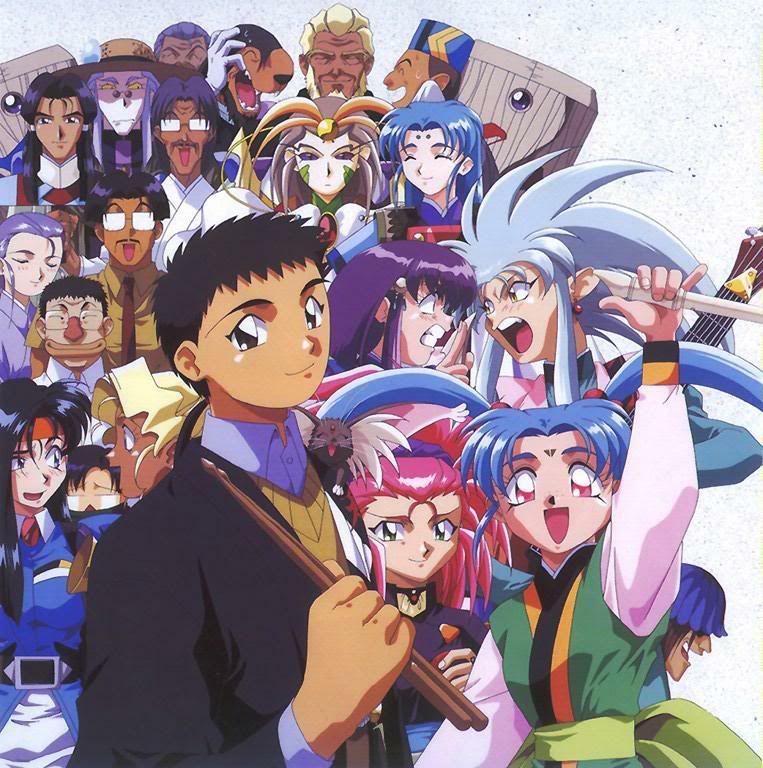
In our discussion of the Tenchi anime series, I mentioned how Tenchi formed the center of a web of different social groups. I compared this to twitter, other online social networks, and the more immediate connections we have with friends and family. Tenchi's first contact is his family. His father and grandfather - even his deceased mother - are his closest ties. Next is work and school - his obligations as a student and as a priest in training. After this, his connection with the various alien women that occupy his home.

Ryoko represents the wild side. A space pirate, she is bold, brash, immodest, crude. Mihoshi represents inexperience. A junior police officer, she is quick to emotions of happiness and sorrow. Ayeka represents tradition and high society. The first Princess of Jurai, she is wealthy, cultured, and haughty. Sasami represents childlike innocence. The second Princess of Jurai, she is honest, helpful, and without guile. Washu represents knowledge and skill. A renowned scientist, she is educated, curious, and inventive. Kiyone represents responsibility. A career police woman, she is meticulous, cautious, and frustrated.

Tenchi's relationship with each girl directly influences them in some way. Ryoko, usually very masculine in behavior, appears more feminine and vulnerable in his presence. Ayeka, normally of a composed demeanor, slips into fits of shameless infatuation and jealousy. The connection is stronger in some relationships than others, but each relationship affects both Tenchi and the girl in question to some degree. Furthermore, each girl influences not only Tenchi, but the other girls as well. Ayeka compares herself to Ryoko, thus confirming her social status. The Washu to Kiyone comparison is likewise clear, though less confrontational.

I have found on twitter that communities, or nodes, form around each profile. First, there were close friends and fellow members of the Legion of Tangent(.co.cc). Along with the Legion was, of course, my wife and fellow podcaster, Brandi. Through the course of tweeting I have met many people. I have met a number of bands, such as Twitch the Ripper and All My Faith Lost... Through the Gentlemen's Grindhouse podcast I have come into contact with several horror fans, bloggers, merchandisers, and podcasters. Furthermore, through TGG I met much of the rest of Geek Planet Online. I am known to tweet a great deal about music, and as such have made contact with several DJs, goths, record stores, and radio stations.

Each follower, for the most part, existed first as a separate entity. Then a small node formed around one profile or another. The InsideOutcast has a community of listeners as does Dark Horizons radio. Gradually, members of a node interacted with members of another. This may be due in part to Follow Friday, but is mostly through referencing other profiles in conversation. Horror fans met Sci Fi geeks, goths met rivetheads. Smaller nodes grew into larger ones as each overlapped with another.

That is not to say that twitter is a melting pot. If so, blocking would not be an option. Some nodes remain separate. Even still, the web is more intricate and broad than it may seem. What happens to one tweep can very well affect that entire node, for good or bad, and may even spread to other nodes. Hence many a trending topic. I know through my own tweets that I have had both positive and negative affects on individual tweeps as well as these communities of similar tweeps. Just recently I convinced a few members of one node to attend a live show at Digital Mindfield Radio. The IDM band, Bioassay, performed live from the house. This may lead to one node forming a stronger connection to another.

I, too, have been drawn into nodes, or rather, into a larger community. Dark Horizons is one such node. Theresa's Silly Question of the Week allowed me to access, through hashtags and mention of @DHRadio, other listeners. By doing this, I discovered tweeps with a similar taste in music, and by extension, a similar lifestyle.

But like Tenchi, the effect a relationship has on us directly correlates to the strength of the connection. Close friends and family have a greater impact on us than, say, a celebrity we happen to follow. Knowing when the next album drops is one thing, but discussing our personal lives is quite another. The celebrity cares little for our tweets. How can what we say matter when we are but 1 of 1,978,325 followers?

The value we hold in a social network is our social capital. Our influence may be stronger over one tweep than another. Furthermore, the tweets from one person may have greater influence over us. If the influence is mutual, then the value of social capital is even higher in that instance. Mutual respect in a relationship is preferred. It is one thing to be a teacher or a student, another to be a friend.

So I would like to thank my many twitter friends for the social capital bestowed on me. I hope not to piss away your investment in me. In the third series, Tenchi in Tokyo, Tenchi's power derives from the social capital, the connection, he has with the girls. The stronger their trust in him and love for him, the mightier he becomes. As defender of the Earth, that power is without price. I, however, am not a defender of the Earth as such. I do not carry a magical sword (yet). Just the same, it is comforting to know that someone out there holds me in esteem.

Monday, December 21, 2009

Step Off: A Brief History of Dance


Scientific study suggests that we humans possess an understanding of rhythm that is lacking in the rest of the animal kingdom. Musicality in animals is accidental at best. In man it is deliberate and conscious. Rhythm forms the backbone of music. The first instrument is the human voice. One can imagine primitive man aping the sounds of nature, of grunting patterns that developed into speech and then song. The beat of the drum and plucking of string was soon to follow. Woodwinds, too. Music is inherently, definitively human. Where there is music there is likely dance. Dance has evolved over time. Yet, many dances retain a primitive quality. Here I present a brief history of dance.

RITUAL DANCE
Early dance was performed ceremonially. Nomadic tribes were deeply superstitious. Sympathetic magic implies that like produces like. If one were to dance out a successful hunt, surely the next hunt would prove successful. Dances of ceremony exist today in the form of many African tribal dances, Native American dances such as the well known rain dance, and even the measured movements of a Daosist priest or Shinto priestess.

FOLK DANCE
As superstition recedes in favor of logic, dances are performed more as tradition than ceremony. Dance is an expression of cultural heritage. Dancing around the may pole, Irish step dancing, Russian folk dancing - these are expressions of cultural significance. Many of these dances remain unchanged over the years.

SOCIAL DANCING
As tradition falls to the way side, dance is viewed as a means to bring couples together. Social dancing is one of the most common forms of dance, spanning a great many styles. Square dancing, country line dancing, latin dancing, ballroom, the Lindy hop, disco - each is a means to bring together prospective young lovers. Even the waltz is a social dance, though for the upper class. Military men were expected to know several dances and perform them at social gatherings whereby they could meet an eligible young woman. On the other hand, some social dances can get quite risque. The French can-can for instance was usually performed by ladies wearing no underpants. Men were sure to glimpse a little somethin' somethin'.

EXPRESSIVE DANCE
At some point, one goes dancing not in order to meet someone, but simply to let off some steam. Here one dances for oneself. Contemporary dance and street dancing are a fair example. In contemporary dance, the dancer expresses the meaning and mood of the song, the body a conduit for the music. Dance is from the heart and extends throughout the entire body. Though it may lack rhythm in many cases, it can quite beautiful. Street dancing is just as much an expression of music, but more urban. Hip-hop, breakdancing, and crumping embody life on the hard streets. Movement reflects this lifestyle. Distinctions between different styles of hip-hop can be drawn simply from where one lives.

DANCE AS ART/ENTERTAINMENT
On the flip side, there are those who enjoy watching expressive dance. Certain people may go to a club just to watch great dancing. At its finest, dance is high art. Ballet is one form of dance that the general public regards as high art. Just about any dance can be considered art. It depends on how much value is placed on that particular dance. Contemporary dance is finding its place as art. Even if dance is not regarded as art, it may be viewed as entertainment. From vaudeville to Broadway to movies to music videos, dance is used to draw and captivate an audience.

So there you have it, a brief history of dance. Note that many styles overlap. Hip-hop can be regarded as social, expressive, and entertaining. The distinction rests in the intent. Are you dancing with someone, for someone, or for yourself?

Monday, December 14, 2009

A Darker Shade of Pale: Ethnic Goths

People may ask, "Why is it I have never seen a goth of color?" In other words, why is it the goth scene so predominately white?

Well, they have a point. The goth scene started in England with the gothic dance pop music of Joy Division. Joy Division in its own right grew out of the punk music scene, a primarily white, Anglo-Saxon protestant movement. Other gothic bands soon followed. Bauhaus, The Cure, Siouxsie & the Banshees, The Sisters of Mercy, The Fields of the Nephilim. As a progression from punk, goth is rooted in British history, politics, culture, and religion. Yet, as a romantic movement, goth moves away from just the social and political arena of England to touch upon more universal issues of loss, sorrow, isolation, and death. There are many references to religion, particularly Christianity, that reflect a more specific society. In some degree this is balanced with Greek, Roman, Norse, and Celtic mythology. Even still, the above represents only the religions of Europe.

In defense of homogeny in the scene, not all goths can be judged by their cover. Many goths, I would even go as far as to say most goths, do not fall into the established stereotype. Black eyeliner, black nail polish, wild hair, clove cigarettes, torn fishnets, ruffles - these are the outward features of the typical goth. Most goths I know may wear black, maybe a band T-shirt, but they don't go out of their way to goth it up. I like to call us basement or subdued goths (sub goths for short). Sub goths don't look goth, but they are. Even DJs and musicians in the scene can be basement goths. So, who is to say that a black man, an hispanic woman, or an Asian fellow isn't a subdued goth? There is more to it than just appearances.

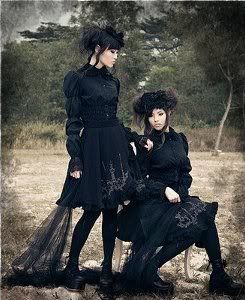
Goth is about expression and sensibility. It is not limited only to the vampire aesthetic. Goth is an ever widening circle embracing many aspects of the dark side of life. Romantic goths embrace the high fashion and social customs of the Victorian or even Elizabethan age, only with a prominent penchant for black, mourning attire. Intricate lace, ruffles, top hats, canes, parasols, veils - these are the finery of the romantic goth. Deathrockers resemble something akin to a punker just freshly risen from the grave. Emphasis is on anti-fashion and horror. Gothabillies embraces the 50s aesthetic of bowling shirts, tweed, leather jackets, poodle skirts, and Betty Page. There are many subcultures within the scene, each with something else to offer a prospective goth.

Furthermore, discussion of race is a sticky topic to begin with. Although there appear to be sharp distinctions regarding national borders and cultural differences, the walls are thinner than one may think. Anthropologically speaking, science can trace our DNA to Africa. In short, we are all African. Each human can trace their DNA back to Africa. We are brothers and sisters one and all. During the ice age, massive glaciers used up much of the ocean water. The seas receded. This allowed early humans to travel across dry land that may once have been a river, a lake bed, a canal. Humans moved up into the Indus valley and eventually settled in Eurpoe and Asia. Humans evolved over time to adapt to the colder climates. Melanin evolved out of the skin and eyes. Fast twitch muscles atrophied in favor for muscles equipped for more prolonged activity. This is not to say whites and Asians are more evolved. Africans evolved parallel to Eurasia, only equipped to handle warmer climates. Even then there are distinctions between East an West Africans and well as differences between mainland Asians and Asians on the Pacific islands. When someone describes a custom or trait as black or white, latino or Asian, this has as much to do with genetic make up as it does environment. There are distinctions between different races that developed over time, but the essence of humanity remains the same.

ASIAN GOTHS
There are several emerging goth scenes in Japan, particularly in Tokyo. Gothic Lolita is a scene in which girls and women dress like dolls. The clothing is very detailed, similar to romantic gothic fashion, very intricate with frills and lace, only with a touch of anime. This scene has grown in popularity and is spreading to Europe, the U.S. and elsewhere. The other big movement is the cybergoth scene. Cybergoth is a blend of rave culture and the goth scene. Cybergoth is largely populated by rivetheads. DJ Sisen is a world renown Industrial/EBM DJ. Not only does she expose Tokyo to Skinny Puppy and Nitzer Ebb, she is a fashion ikon in her own right. She dresses in visual kei, wearing quite outlandish and colorful outfits and applique to her eyelashes, etc. Japan's greatest contribution to the goth scene has to be the fashion. The trends and designs in the visual kei arena definitely take gothdom in a new direction, taking dark fashion into this next millennium.

Musically, the goth music of Japan tends to be J-rock with horror elements. Marilyn Manson is often cited as inspiration for the scene. A J-goth band worth mentioning is Chako, an ethereal band from Kobe. The music is lush and sorrowful.

Chinese culture is not one for diverse expression, being a socialist nation. However, many Chinese Americans and other Chinese living outside mainland China follow the way of the goth. Goth is quite rare in the rest of Asia as well, finding expression only when apart from the dominant culture. Asian Americans and Asian Europeans are more likely to demonstrate gothic tendencies or have gothic tastes. This may have something to do with the immediate environment. If .

LATIN GOTHS
Mexico has had a long love for the vampire and other stories of dark romance. South America, too, possesses an air of mystery and wonder. The Aztecs and the Mayans are just as mysterious as the Druids and Celts of Europe. So it is little wonder that members of the Latino community would adopt goth as a culture. There is an hispanic gothic community in the Bronx. It is a tight knit group that had been featured in the New York Times. Of course, the members of this circle of goths have suffered persecution from parents, neighbors, and the like. These goths run the gamut from trad-goth to rivetheads.

And speaking of rivetheads, Hocico is an industrial band from Mexico City. They took inspiration from Skinny Puppy and similar bands. Their style is acerbic, yet beautiful, ranging from aggrotech to endzeit electro. Endzeit is usually limited to Germany. Hocico performs mostly in Spanish. They are getting more recognition all the time and currently tour all over the world. A number of other hispanics populate gothdom in one form or another.

AFRO-GOTHS:
Goths of African descent, or afro-goths, are fairly rare. However, they are not unheard of. According to an Internet pole, 51% have met an African American goth or emo. However, most of the yes answers are from the midwest and the south, both having in sum understandably less insight into the gothic community, and therefore more likely to give an incorrect answer.

A problem, especially in the U.S., is that there is a great deal of pressure on black Americans to hold onto their cultural heritage. As they did not come to America willingly, it is understandable that many African Americans resist complete assimilation. As such, they keep to the culture of Africa in music and dress. The biggest contribution to the black American experience is the development of a new culture. Blues, doo-wop, hip-hop, rap, and funk (and many would say rock & roll) developed in America as a means of black American expression. However, more and more white America emulates black culture. Vanilla Ice, Kid Rock, eminem. These represent stages of reverse assimilation. White kids disassociate with their white roots. Eminem is more widely accepted today than Vanilla Ice nearly 20 years ago.

The mistake is assuming that black goths are trying to appear white. Goth is not a white issue. Goth is about self-expression. The black goth is attracted to the same things as a white goth or a hispanic goth. Truly gothic folk tales have a rich, African tradition. Perhaps the person grew up in a white, suburban neighborhood and therefore lived the "typical" goth experience. Whatever the case, something appeals to the individual and draws him or her into the scene.

Sadly, many blacks still possess a misconception of goths, believing them to be racist skinheads, devil worshippers, etc. Although these elements do appear in the scene, they are not the scene. Just as some blacks are gangstas doesn't mean all are. There are black CEOs, black authors, black producers, black bankers, black physicists. Even in the rap community not all rappers are gangstas. The Rza is deeply into Eastern philosophy. The fact is there is a fair amount of resentment towards any kind of alternative culture in the black community, just as in other communities. Goths, being so very obvious, make an easy target. It is the same attitude white people had when members of their community started to adopt the black culture. Wiggers became the derogatory term for these individuals, sometimes even if they grew up in the same socio-economic environment. The black goth can be viewed as a traitor to her race.

Just the same, some afro-goths do overcome this opposition and express themselves fully at the expense of ridicule or exile. There is a black gothic Lolita community, embracing the Japanese goth aesthetic. There are black goths within the vampire community. The Vampire Club in New York features several regulars. Romantigoths, candy goths, death rockers, even gothic belly dancers all find a place in this small community. A considerable section is taken up by rivetheads. Industrial/EBM may have teutonic beats, but the content is mostly about politics and urban decay. These subjects are the same posed by Public Enemy and other rap artists, only the music is ever so slightly different. Even the technology is the same, lifting hooks and beats from other sources. Laying in samples from television, movies, and radio. Industrial music reflects the anger and frustration of living in a post-industrial society. One of the top cybergoth communities is based in Detroit, a city with a large black population.

An unexpected drawback of the African goth is difficulty finding a suitable life partner. Sure they could go outside the black community, but why should they if they don't want to? A black goth seeking a black goth must be a nightmare and I do not envy them for it. However, I do wish them the best of luck. Several websites are devoted to bringing together members of the black gothic community to offer support, to enlighten, and to accept. Many afro-goths come to the party late and have to play catch up. This means many questions asked regarding fashion, slang, customs, and music. For any aspiring afro-goth, I would suggest getting on Last.fm and entering the following tags. Goth, Gothic Rock, Darkwave, Ethereal, Industrial, EBM, Horrorpunk. This should provide you the opportunity to choose those artists that best fit your tastes.

Black goth bands are considerably rare. Code Industry is our best example. They were a politically charged, coldwave group in the early 1990s. Blacks have contributed individually to the goth-industrial scene. Reggae vocalist, Morgan Adjei, lent his stylings to KMFDM's album UAIOE on tracks like Murder and Loving Can Be an Art. On Front Line Assembly's album, Millennium, Che the Minister of Defense provides rap vocals to Victim of a Criminal. Duane Buford provided keyboard and spoken word vocals on Revco's Linger Ficken' Good.

It is disappointing that so few black musicians actively contribute to the goth scene. There is definitely room for goth from a black perspective. I would be interested to see what direction black musicians would take darkwave music. The contribution of blacks to medical science, music, film, and sport is considerable. The joy of goth is adaptability. Goth can be shaped to the viewpoint of the musician. Christian, pagan, sadomasochistic, satanic, romantic - a number of approaches are open for the aspiring afro-goth. Hopefully, the fans today will grow into the musicians of the future.

Black musicians have contributed to the goth scene even though they are not goths. Michael Jackson's Thriller, speaking as a goth, is a brilliant tribute to the horror scene. The lyrics refer to just about every cheesy creature feature of the 50s. The video equally addresses zombies, werwolves, and such. It is just good fun. Prince's outlandish costumes granted blacks the ability to dress similarly. Dressed in period victorian ruffles, one's peers would regard one as a Prince fan and not a goth. This is a mixed blessing, surely. Musically, goth owes a great deal to black culture. Reggae inspired punk, and punk inspired goth. Blues music, too, influences a good deal of early goth. Meanwhile, hip-hop and rap have inspired the new sound of Skinny Puppy as well as the aggrotech vocal stylings of Angelspit and the peculiar mash-up that is Stromkern. Tribal beats form the foundation of many goth songs, particularly by artists like Tigerlily and Drumatic.

The gothic-industrial scene has gone global. Bands, fans, and DJs live in or can trace their heritage to the following countries: Afghanistan, Australia, Austria, Belgium, Canada, Denmark, England, Finland, France, Germany, Greece, Ireland, Italy, Japan, Lebanon, Mexico, Norway, the Philippines, Scotland, Slovenia, South Africa, Sweden, the United States of America, and Wales. And this is just off the top of my head.

Occasionally, white goths receive venom from the ethnic goth community. White goths are condemned for being too homogenized. Same fashion, same music, same background. This attack fails to consider the broad range of goths within the white community. It seems a feeble attempt to validate the ethnic goth movement by creating a straw man argument. White goths are all the same so they are boring and irrelevant. Ethnic goths are all different and therefore interesting and relevant. Every white goth, and every goth of color I know, is a unique individual. There is no place in the debate for such baseless attacks. Allow those to express themselves as they choose fit just as you would permit yourself the same. The same person who says that all white goths look the same turns around and in the next breath says that racism has no place in the goth scene. I am left scratching my head.