Showing posts with label Literature. Show all posts

Sunday, June 19, 2011

The Green Lantern and the Monomyth

That a superhero movie follows the monomyth is no great surprise. The interest is in how each movie treats the hero's path. The new Green Lantern movie features many of the signature elements of the hero's journey. The treatment ranges from the cliched to the surprising.

First and foremost is the apotheosis of the father. Hal Jordan is the son of a fearless test pilot. As such he must live up to those expectations. He walks in the footsteps of his father, yet never feels he is adequate. Irresponsibility stems from doubt. Since he inwardly feels unworthy he, whether consciously or unconsciously, sets himself up to fail. The culmination of these fears occurs in his stalled descent in a fighter jet. Hal misses the opportunity to control his plummeting plane because he relives the moment of his father's death. Frankly this could have been played out more efficiently. With Top Gun and the parody Hot Shots, this scenario has the mark of cliche.

The we have the encounter with the gods and the call to adventure, these two scenarios being inexorably linked in Green Lantern. With the crash and imminent death of Abin Sur, Hal Jordan is selected by the ring and brought to the injured alien. Despite the information overload of being whisked through the air and confronted by an alien spacecraft, Hal shrugs off this disorientation when he spots the injured Abin Sur. This is one of the first of the tests and trials Hal faces in order to prove his worth as a hero.

Abin Sur, as messenger of the gods, offers Hal the power of the ring. The ring here represents the magical weapon, the gift of the gods imbued with the power to fight evil provided the hero is worthy. The lightsaber from Star Wars is such a weapon as is Thor's hammer. But with the power of the ring comes the responsibility of using it wisely. Hal, who has shown up to this point a knack for irresponsible behavior, must overcome his past self to become the hero of destiny.

The call to and refusal of adventure is treated somewhat differently in Green Lantern. At first Hal is eager to accept the call. He swears an oath must further prove his mettle in the underworld, here represented by the planet, Oa. Oa is home for the Green Lantern corps. It is the source of their power. In a mythic sense it equates to Mount Olympus or Asgard. Oa houses the gods. Journeying to Oa, Hal Jordan is first prepared in a baptism of pain. His body is made pure that he may interact with the gods, i.e. the other Green Lanterns. As he explores more and more of Oa, he encounters creatures stranger than the next. Now Hal is a visitor between worlds. His gift removes him from humanity and his humanity separates him from the aliens on Oa. At this time he is the most alone and the most vulnerable.

He is aided by two aliens, other messengers of the gods, who provide him with tests of skill regarding the mind and the body. It is Sinestro, though, who tests Hal's spirit. Sinestro, played by Mark Strong, enters as Hal's rival, filling a role for a bother battle. Hal must match or surpass Sinestro in skill to be found worthy. That Hal fails in this test is the seed of his decline. He rejects the call to adventure and returns to the Earthly realm as a quitter.

It is only when his own realm is threatened that Hal reclaims his charge. All this while evil has taken root on Earth in the form of Hector. A wayward scientist, Hector is infected with evil. It claims his mind, body, and soul. Hector is Hal's shadow. They love the same women. Both have father issues. Each is crippled by self doubt. While Hector is corrupted by his feelings, Hal acknowledges and controls them. He returns to Oa only to be refused assistance. The gods turn their back on him. He confronts the gods, and Sinestro, and oversteps his place.

Hal battles evil on his own, knowing that he is outgunned. He is fully actualized. He uses the skills he has learned along the way, as well as the magic weapon, to defeat evil. In his moment of self sacrifice the gods accept him and rescue him from death.

There are several other elements at work here as well, but that is the gist of the monomyth. It's pretty straight forward. This may, in part, be the source of much outcry against this film. Much seems familiar. Some have remarked that Green Lantern is just The Last Starfighter, failing to grasp that they share the same mythic elements, not the same story and characters. However, other films have been more effective in telling the story. While the script is not as sparkling as Thor or X-Men: First Class, it is a far sight better than the new Star Trek or Tron: Legacy. In short it falls somewhere between, sharing a spot with Iron Man 2. The principle actors surpass the script to deliver a movie that is much better than it could be.


Monday, August 23, 2010

Conscience of a Killer

There is a theory regarding serial killers. Even the most gruesome murderer wants to be caught. The trademark mode of operation, the calling cards, the letters to the police and the press may not be just a few strokes of the ego. These tropes may be desperate cries to stop the cycle. Granted this is just one theory.

However, the guilt of the murderer plays an integral role in literature. For instance, in Edgar Allen Poe's The Tell Tale Heart, having slain his neighbor, a tenant hides the body under the floorboards. Meanwhile, police were informed of a scream during the night and interview the murderer. The man covers up by claiming the scream as his own. During that night he hears the beat of a heart, the heart he assumes to be that of the victim. This paranoia builds and builds. He is shocked the police do not hear the sound. Finally he confesses to the crime, the beating heart to loud to ignore. It turns out the heart beat he heard was his own, a manifestation of guilt.

Dostoevsky takes a similar approach. In Crime and Punishment, a young student murders his greedy landlady with an ax. However, an innocent woman walks in and in a panic he kills her as well. The guilt of this unintended murder haunts the young man, eating at his soul. Meanwhile, the investigator circle ever inward. The student meets a poor woman and falls in love. He finally turns himself in, atoning for his crimes by pursuing a Christian life and living out his sentence in peace.

The Brothers Karamazov is the story of four brothers dealing with the murder of their father. Each of the four sons has some motive for the murder save the next to youngest, Alyosha, who is pursuing a life of religion. Dmitri, The eldest son, is romantically involved with his father's mistress, and spending money liberally, seems the most likely. Ivan, the middle son, is a student and atheist whose cold logic appears to make no room for morality. It is this approach that inspires the youngest son, Pavel, an epileptic bastard, to confess to the murder. However, it is the student who feels the most guilt. This guilt manifests in hallucinations and poor health. At one point he imagines the devil speaking with him, undermining his atheistic beliefs.

Even in Fritz Lang's M, the murderer feels guilt for his crimes, or at least claims to. The spirits of the slain girls haunt his every moment, silenced only when he is in the act of pursuing, molesting, and killing. In his breakthrough performance, Peter Lorre brings a pathos to what is really a hateful, cowardly character - a child murderer. Whether the guilt he admits is real or not is left for the viewer to decide.

If we train our conscience well it will kiss us as it bites - Friedrich Nietzsche

Sunday, May 2, 2010

When Love and Death Embrace

Throughout literary history, even extending down through oral tradition, love has been associated with death. The two concepts intertwine like a worm around a rose, one feasting upon the other. Just take a studied look at stories throughout the ages and you will find love and death embracing.

LITERATURE
One of the earliest meetings of love and death in story form took place on the stage. In Oedipus Rex, Sophocles has the title character kill his father and marry his mother. His mother, Jocasta, knows that Oedipus is her son and marries him anyway, even begetting children with him. When Oedipus realizes what he has done, Jocasta cannot bear his grief. She retreats to the bedroom and hangs herself. Oedipus is so distraught that he gouges out his own eyes, claiming that a blind man sees the truth more clearly than he.

Shakespeare, too, explores this dark side of love. In Hamlet, Ophelia is driven to madness by Hamlet's peculiar displays. No longer able to cope with his drama, she drowns herself in a river. We all know how Romeo and Juliet ends - with each committing suicide. The young lovers would rather die than live without one another. In Othello, Iago fills the king with such jealous rage that he kills his queen. These three examples show the broad range of how death follows love. Death is brought on by despair, loneliness, or jealousy.

Novels are no different. Love and death are frequent partners. Tragic love stories abound, usually centered around obsession. The tragic love story, just as in the stage play, ends in murder or suicide. Consider The Collector by John Fowles. A man is driven by obsession so far as to abduct the woman of his desire. He keeps her in the basement. His attempts at seduction fall flat. Finally she concedes to his advances only to attempt an escape. Her failure ends in death. The man simply moves on to his next obsession.

Poetry, too, follows love to the bitter and tragic end. Lord Byron is but one example. His poems drip with obsession, desire, and forbidden love. Although this results primarily in exile, sometimes it ends in death. El Cid, an epic poem from Spain pits the love between characters and one's sense of duty. If you are in love with the princess how can you kill her father, the king? The conflict between love and duty is a motif in many stories.

FILM AND TELEVISION
It is no surprise that love and death would make the transition from the page to the big or small screen. Gothic horror plays with the pair quite well. The Phantom of the Opera, The Bride of Frankenstein, and The Creature from the Black Lagoon pursue obsession and unrequited love. The monster seeks love only to be rebuked. In anger the monster either murders the source of its obsession or in turn is destroyed. King Kong is a premier example of beauty killing the beast.

Film Noir explores dark obsession in less metaphorical terms. Here the woman tempts the hero, leading him astray. She uses her wiles to lead the male character to commit murder. The femme fatale is the very love child of sexual desire and death. Hers is a poison kiss. There is unlikely a better example than Double Endemnity, wherein an insurance salesman murders a man so the two lovers could share in the return from the life insurance policy.

Modern movies and TV shows carry on the traditions of gothic horror, film noir, and literary history. Daytime soaps are rife with these themes. Love and death might as well be a series title.

MUSIC
In my opinion no other medium enchants the soul quite like music. A well crafted lyric over a melody conveys a powerful emotion. Themes of love and death seem custom fit for a singer-songwriter. The darkwave scene including gothic rock attacks these themes with abandon. The loss of a loved one, dark obsession, unrequited love, no one does it better than a gothic rock band. From Siouxsie's Obsession to The Cure's Pornography, from Christian Death to Paralyzed Age love and death have featured prominently.

The love and death gestalt has transcended lyrical content to interfere in the lives of the musicians. Ian Curtis trapped in a loveless marriage and in love with a reporter one day hanged himself in his home kitchen. Then there is the well known case of Sid and Nancy, a tumultuous affair fueled by drugs, alcohol, and other excesses and ending inevitably in death.

I know of know other band that weaves love and death so frequently and skillfully than HIM. Ville Valo's lyrics blend love and death so well that they become one and the same. Even covers like (I Just) Died in Your Arms Tonight and Don't Fear the Reaper contribute to his leitmotif. Take a look at some of these song titles and decide for yourself.

The Funeral of Hearts, When Love and Death Embrace, Buried Alive By Love, Poison Girl, Killing Loneliness, Heartkiller, Vampire Heart, Lose You Tonight, Like St. Valentine, Passion's Killing Floor, It's All Tears (Drown in This Love), Join Me in Death, Dark Sekret Love, Love and Cold Blood, Dead Lovers' Lane, not to mention the lyrics within less obvious titles.

Monday, March 15, 2010

On Satire

Satire is a means for making the ridiculous stand out, often by carrying an argument or opinion to the extreme. Although used primarily for comedic effect, the goal of satire is to expose some perceived evil, often that of an opposing viewpoint. Thus, satire often takes the form of a polemic. In some instances the satirist will assume the position of his or her opponent in the form of a parody. Parody proves effective if performed straight or as pantomime. However, although playing it straight adds gravitas, there is a danger of being take too seriously. Straight parody often goes over the heads of the more ignorant.

SATIRE ON THE STAGE
The pen of the playwright is often the tool for insurrection. Aristophanes, author of many of Ancient Greece's famed comedies, is regarded as one of the best satirists. In The Clouds Aristophanes turns his critical eye to philosophy. The plot involves an indebted father who enrolls his son in The Thinkery that he may learn rhetoric and defeat their accusers in court. A little knowledge is a dangerous thing, however. The boy learns instead to turn his back on social customs and moral behavior. Following an argument, the boy batters his father. Outraged, the father burns The Thinkery to the ground. Aristophanes portrayal of philosophers, Socrates in particular, was pointed out by Plato as one of the leading causes of Socrates' subsequent trial and death. Socrates indictment was that of corrupting the youth, an accusation that mirrors his character in the play.

SATIRE IN POETRY
Roman poets Horace and Juvenal are to satire what Plato and Aristotle are to philosophy. Horatian satire is light hearted, often poking fun at one's own vices. The goal is to provide insight in dealing with social problems. Juvenalian satire is often bitter. It is caustic in the way it shines a spotlight on some social ill. It seeks to ridicule. Satirical poetry had a considerable run during the 18th century with such poets as Dryden and Pope at the quill. John Dryden is famous for his mock-heroic satires, particularly MacFlecknoe, an attack on the poor literary sensibilities of his contemporary and rival, Thomas Shadwell. In a word, Dryden paints him as dull. Sadly, libel laws have nearly put an end to the polemic poem in England.

SATIRE IN ESSAY FORM
The direct and formal nature of the essay makes for a good polemic. Yet, because of the serious tone in most essays, satire in essay form is easily misconstrued. Take for instance Jonathan Swift's famous essay, A Modest Proposal. In it Swift suggests that to end poverty and starvation in Ireland you need to introduce but one policy, eat babies. In this regard, you cut down on the population, feed the starving, and cut costs of raising children. The number of complaints from people who took this seriously is staggering. In his essay, Swift meant only to bring attention to social ills. When writing a satirical essay it is perhaps best not to overestimate one's readers.

SATIRE IN FICTION
The novel and the short story present ways an author can introduce satire in narrative form. Children's literature, strangely, serves as one of the best options. Carrol's Alice in Wonderland and Through the Looking Glass contain several elements of satire. If one looks as the red and white chess pieces as political figures, the satire comes through. The Red King and Red Queen represent conservatives. They are combative and accusatory, the Red Queen often shouting, "Off with her head!" This iron grip and war like attitude is typical of republicans. Then you have the White King and White Queen that represent liberals. The White Queen is anxious and flighty. She means well, but is utterly incompetent.

SATIRE IN SONG
For those who could not read or write, the song proved a welcome tool for satire. As such, satirical songs were prominent in the Middle Ages. However, even the literate lace songs with acerbic wit. Voltaire (the musician, not the philosopher) has written and performed many satirical songs. One of the most blatant and scathing is "Bomb New Jersey." Voltaire grew up in New Jersey and suffered the abuse of the many, ignorant people there. Being goth and having a hot girlfriend did not help matters. Voltaire takes revenge in this anthem. "God Thinks" addresses the hypocrisy of those who claim to know the wishes of God. "Mr. Irresponsible" is an attack on those who live with little regard for the environment.

SATIRE IN FILM
Parody plays well on film. The Marx Brothers and Charley Chaplin have used the Silver Screen to knock the legs out from under the haughty-taughty. The latter also displayed the life of the unemployed during the depression, characterized by his lovable, yet hapless tramp. The Great Dictator is Chaplin's attack on Hitler and Mussolini. When the film was made, they had no idea of the atrocities that had been committed against the Jews. In retrospect the tone of the film seems a bit light and frivolous.

SATIRE ON TELEVISION
The immediacy and the regularity of television makes it a good source for satire. From very early on the sketch comedy show, Saturday Night Live, offered comedy writers a timely shot at bad politics. Spoofing presidents has been a long standing tradition. SNL also features a fake news segment called "Weekend Update." The fake news banner has been taken up by Comedy Central in The Daily Show with Jon Stewart and The Colbert Report. In the Colbert Report, Stephen Colbert takes on a conservative persona, a construct of Fox News reporters Sean Hannity, Bill O'Reilly, and Glenn Beck. As parody, Stephen emulates their "journalistic" style, only going the next step into the ridiculous. Often he has no need to as whatever the originals may say need only be repeated, as it is already ridiculous.

Saturday, February 13, 2010

Jungian Pooh

As promised, I present the personalities of the characters in A.A. Milne's classic, Winnie the Pooh. I am not the first to compare the inhabitants of the 100 Acre Wood with modern personality types. The Tao of Pooh and The Te of Piglet by Benjamin Hoff does this quite well. This is not a stretch, however. Clearly each animal is meant to represent some Jungian archetype. Here I shall list the character, his or her traits, and the modern equivalent.

Eeyore
The blue donkey known as Eeyore is blue for a reason. Eeyore is the epitome of apathy, dispassion, listlessness, and depression. The somber Eeyore is a pessimist. He lives in a simple shelter of a number of piled together sticks. Why? Because that is the best he can hope to get. He falls in a stream and floats and floats, never struggling to make his way to the bank. He waits for someone to help him out - just as long as it is no bother. His unwillingness to provide for himself coupled with the passive-aggressive manner are the main traits of this mournful quadraped. Nevertheless, many of us love Eeyore dearly. Why? Because the little Donkey that couldn't appeals to our own melancholy.

Learned helplessness is the psychological basis behind apathy. Repeated failure leads to no longer trying. If a dog is placed on an electrified floor and has no means of escape, it has little choice but to lament the situation. Repeated experiences in this electrified room conditions the dog to this state of being. One day, when a partition is removed to allow the canine and escape from discomfort, the dog does not take the opportunity. Experience has proven that escape is impossible. Why should this time be any different.

So it is with man. Repeated failure conditions us to anticipate failure. Like Eeyore, we do not strive as hard as we should. We do not swim for the bank of the river. When we accept failure as the only outcome, an attempt to change the situation seems futile. Why bother? As such, many of us remain in a less than desirable position simply because no other option presents itself - or so we think. The pessimist does not bother hoping for the best, let alone taking action to improve things.

That is not to say the Eeyore personality is joyless. The pessimist can find value in the small things, in consistency and routine. Even isolation can provide solace for the blue. Eeyore does not seek to be with his friends. If they come by, fine. So much for misery loving company.

Gopher
Gopher is not a very popular character. The blind, gruffy rodent is an industrious sort. He is known to be digging his tunnels into which other characters occasionally fall. Gopher did not appear in the storybook. he is an invention of Disney, based primarily on the beaver from Lady and the Tramp. Gopher typically whistles through his teeth as he speaks. He also has very poor eyesight.

Gopher represents the older generation, primarily the veteran generation. Those that experienced WWII and/or lived through the great depression have a strong work ethic. They are stern, no nonsense people with a strong moral center. It is clear that gopher is meant to be older. Furthermore, Gopher spends most of his life underground. Much like older generations hole up in their homes, are wary of new technology and recent trends, and the like - Gopher's existence underground and in the dark is more literal than symbolic.

Despite unfamiliarity with current trends, the older generation has experience. Gopher's experience often comes in useful. Wisdom, too, is an asset of the older generation. Gopher embraces this dichotomy of wisdom and experience and contemporary ineptitude and conditions of age.

Kanga
Kanga is the only female character in the storybooks. As mother to Roo, she embraces the aspects of motherhood and femininity. She is affectionate and protective. Though not very educated, she is naturally inclined to do the best for her son and by extension her friends. Later, she welcomes Roo's friend, Tigger, into their home.

Clearly Kanga is the archetypical woman, combining elements of the Empress and the Priestess from the tarot. In one respect, she is mother and protector. The matron of 100 Acre Wood, Kanga is the primary caregiver. Meanwhile, she incorporates women's intuition, that knowing without knowing. She knows when there is trouble, when her son is in danger. She also knows when someone is playing a joke on her.

Owl
Owl is a bespectacled bird living in a stately home high up in a tree. Owl is educated, or so he thinks. He is able to read and write, almost. He is quick to advice, instruction, and anecdotes regarding distant family members. Owl explicitly embodies the archetype of the educator. He is an academic.

Academia is under the illusion that it is providing young minds with the assets necessary in surviving the work a day world. However, real life is often worlds apart from the class room. The teacher is often removed from reality, living in an ivory tower of textbooks and chemistry sets. That is not all. A little knowledge is a dangerous thing. Armed with half the facts, the academic is prone to fill in the blanks with supposition. That owl assumes Piglets home is his own is such a leap to conclusions.

Owl is quick to state some meaningless fact, which typically is false or only half true. I, too, find that I offer facts, opinions, advice, etc. a little too freely. There is something owl like in my manner. Even this blog has the mark of the owl. A bit preachy, a bit self-aggrandizing, a bit pedantic.

Piglet
Piglet is Pooh Bear's very best friend. He is very small and knows this to be true. His small stature makes him timid and meek. He is fearful, even of his own shadow. Yet, he has a big heart.

The funny thing about those of a nervous disposition, those that jump at shadows, is that when a real crises presents itself, often they overcome fear. It is as though the truly frightening is beyond their capacity. Those that jump at the shadow of a beast when confronted with a beast do not jump. In the Te of Piglet, Hoff expounds on the virtues of the small, the integrity of piglet. He is righteous in a nonjudgmental fashion, he is brave when courage is required, he is loyal when friends are troubled.

Piglet has many qualities I admire, and by extension those qualities I find in people. Humility, compassion, caution, loyalty. These traits make up a good friend.

Rabbit
As discussed in the podcast, Rabbit is the least liked of the inhabitants of 100 Acre Wood. Rabbit can be summed up in one word, stress. He places an exorbitant importance on things. He guards his garden from Tigger and Gopher. He protects his honey from Pooh. We fails to grasp the concept of sharing, the enjoyment to be had by giving to friends. Simply, he cannot let go.

We are familiar with the type, the workaholics, the micromanagers. Those who place too much importance on things, on routines, on the destination and not the journey will only find dismay. The four noble truths of Buddhism state that 1) life is suffering and that 2) suffering comes from attachment. Attachment is the process of identifying ourselves with objects, in a sense actual objects of desire. Cars, yachts, houses, clothing, electronics, anything that can be consumed. These are fragile things with no real value outside that we attach to it. By strapping our sense of self to these objects, our ego, too, is just as fragile and hollow.

The Rabbit personality claims to own things, but they really own him. Consider how much time he spends in his garden. If he only knew that gardens naturally grow.

Roo
The sun of Kanga, Roo is the embodiment of child like innocence. A friend of Tigger and Piglet, Roo is playful, with that spirit of adventure that most boys have. He balances Piglet, as he draws the gentle pig out of his comfort zone. He balances Tigger as, though found of activity, Roo is more responsible.

Back to the tarot, the first card, the 0 card, is The Fool. The Fool represents child like innocence and that sense of adventure. The Fool is fearless, as all young boys tend to be. Death cannot touch him. The Fool is an optimist as well, with eyes fixed on the distant horizon and not the dangerous precipice before him. Roo, and children like Roo, carry this spirit in their hearts. Some maintain this adventurous spirit into adulthood, becoming test pilots, explorers, astronauts.

Tigger
Nearly everyone's favorite character, usually with the exception of Pooh, is Tigger. Tigger is bold, brash, exuberant, friendly, outgoing. He embodies those traits that make one popular. He seems entertaining, certainly fun at parties. And Tigger means well. There is no question that he appreciates having friends. He is the very epitome of the extrovert.

However, there is a down side to Tigger. Consider if you would like Tigger as much if he were real and an actual friend. Where ever he goes, he leaves a trail of destruction like a tornado. He is a whirlwind of activity. One is reminded of either someone with Attention Deficit Disorder or a major sugar high (or some other stimulant). Life with a Tigger personality, though exciting, is also exhausting. Tigger types love life, and seek to squeeze every drop of enjoyment from life. Sadly, this often leaves everyone around them drained.

Tigger types, though lovable, are best experienced in small doses.

Winnie the Pooh
The bear of very simple brain, Winnie the Pooh, is a strange archetype for a hero. He is absolutely without guile. If he comes to your house, he willingly admits that he has come for a jar of honey. True, he may engage in some pleasant conversation as well, but his motives are there on the table. He is by no means a thinker, he is not even that much of a doer. He just is.

In the Tao of Pooh, Hoff compares these qualities with those of the Daoist sage. The goal of Daoist path is to return to simplicity. When your only concerns are food and sleep, then you have stripped away all the extraneous detritus from your life and are just that closer to wuji - the state of formlessness comparable to nirvana.

Pooh is what he is. Sadly this is looked down upon in our society. A lack of ambition is viewed as laziness. Honestly is regarded as crude and blunt. Simplicity in speech and manner is deemed unsophisticated to downright stupid.

Yet Pooh Bear forms the hub of this circle of friends. Each knows what they may expect of Pooh. Pooh has no hidden agenda. Even Rabbit tolerates Pooh to some degree, setting aside a few jars of honey for when the gentle bear drops by.

So, there you have it. The personalities of the characters devised by A.A. Milne as compared to our own personality archetypes. Which are you? Well, I think each, even Rabbit, reside in our hearts. That we feel a certain way about each reflects on how we view those separate elements of our psyche. That I find my knack for pedantry an embarrassment, yet regard my timidity with less disdain directly correlates with how I view Owl and Piglet.

Saturday, January 23, 2010

Selfishness and Selflessness

There are two opposing views of moral philosophy and they are mutually exclusive. On the one hand, morality is self serving. This is known as objective egoism as put forward by novelist, Ayn Rand. The other system of morality serves others. It is altruistic as in Christian charity. Each system has benefits and liabilities.

OBJECTIVE EGOISM
Ayn Rand's philosophy of enlightened self interests suggests that the right thing to do is that which benefits the self. There is nothing in nature that conditionally guarantees the survival and well being of an individual. To promote one's own being, one has to serve one's own interests. No one is required to feed you, clothe you, shelter you. Your subsistence rests on your shoulders alone. In that respect, actions that do not promote the self are not morally right. They cause more harm than good.

This is a difficult concept for most to wrap their heads around. We are taught from a very young age to share our toys, to put the needs of others before our own. Rand would say that this is ultimately detrimental to society. If we continually give of ourselves to help others, we will eventually have nothing for ourselves. On the other hand, if everyone reasonably serves their own interests, then each has their needs fulfilled. The stress is on reason. One's best interests must be rationally determined. The individual need not serve every whim. Rand denies the equation of the objective egoist with the selfish brute. Most view selfishness with the bloody tooth and claw of some Nietzschean superman, treading over the bones of his enemies in order to claim his prize.

Satisfying every whim is irrational and in the long run will not further one's goals. In fact, that which will better serve the advancement of the ego is pushed aside. Hard work, creativity, ingenuity - these things are shoved aside for no other purpose than to sate one's appetite. Rand would regard this as shallow. It is acceptable to satisfy the appetites, but not at the expense of one's best interest. Drug addiction, alcoholism, womanizing in the end will do more harm than good.

On sharing and charity, objective egoism turns a critical eye. Giving to charity does not serve the self. Moreover, it insults the receiver of charity. As the moral principle is self serving, to serve someone else's interests is to deny them the independence of their actions, which damages the self esteem. Charity breeds pity and resentment. Sharing breeds resentment as well. A possession shared loses it's value the more people share their enjoyment of it. In the Fountainhead, Gail Wynand purchases a statue that he keeps in a private museum. It exists only for his enjoyment. This same statue of a nude woman was once viewed by the ignorant masses with disgust. In Wynand's possession, the statue maintains its artistic integrity. If beauty is in the eye of the beholder, then it is as beautiful as Gail says it is. This suggests that all art should be privatized. The Mona Lisa, beloved by nearly everyone, is actually worthless as is anything meant for public consumption.

Objective egoism is a hard philosophy to follow. The serving of one's own interest above all just goes against the grain. It pits the individual against society by putting the individual above society. Followers either commit suicide, end up in therapy, or abuse or misunderstand the moral principles. It is a philosophy for perfect men. As there are no perfect men it is designed to fail. It arms the selfish with an excuse to be selfish. Furthermore, objective egoism requires one not to believe in god. Belief in the existence of God presupposes the belief in the gospel. If one believes in God, he either follows God's laws or disobeys God. By behaving selfishly, he defies God's laws. The irony is how Christian conservatives cling to Rand's philosophy. This demonstrates just how far Christians have strayed from Christ's original teachings.

Ayn Rand was of Russian descent. She understood all too well the dangers of socialist thought. That society could take the property of an individual and distribute it willy nilly across the population was something she held in great contempt. As such, she developed her capitalist system of man worship to firmly plant the individual above society.

ALTRUISM
Christian charity, as well as socialism, suggests that the moral principle stems from the serving of others before the self. Sacrifice is crucial to both systems. In Christianity, Jesus gave up his life to take on the sins of man (depending on how you view the crucifixion). In socialist Russia, men gave up their property, their desires for some utopian future. While Jesus had at least the benefit of being glorified and worshipped, Russians had to work long hours, stand in lines for toilet paper, and suffer under the iron hand of an oppressive government.

Even so, there is something appealing about doing things to benefit others. Whether it is donating to charity, helping an old woman across the street, digging a neighbors car out of the snow, or just holding the door open for someone carrying bags - helping is satisfying on a deep level. But is it right? Is Rand correct in that we deny others their independence. Do we pity them or cause resentment. Well, if the help is not wanted, certainly. On the other hand, there are those moments wherein one is grateful to receive help.

Why do we help others? Is it for this sense of satisfaction? Is it to stroke our conscience? As Nietzsche wrote, if we train our conscience well it will kiss us as it bites. Perhaps we help others out of a greater sense of community. I help those in distress that one day, when I am distressed, others may help me. However, this in not a truly selfless act. Even being charitable because God ordains it is not selfless. To do good in order to get to heaven suggests an ulterior motive, making the act selfish. Can one truly be altruistic?

Selflessness cannot be a total conviction. If one feeds other before feeding oneself, then one starves in the end. Complete selflessness is unattainable. One can only help when possible. Also, is one obligated to assist the misfortunate? It is one thing to donate your time and money in a time of need. The drought in Ethiopia or the recent earthquake in Haiti marks a period of need, where people give from the goodness of their hearts. However these are widely publicized events. People are starving all of the time all round the world. Are they any less worthy of help? Are we obligated to help everyone less fortunate than ourselves? If so, then the quality of life for everyone must be equal. This is the goal of socialism, to bring the quality of living of every individual to exactly the same level. The doctor is on par with the village idiot. There is no distinction made based on personal merit, not on skill, not on contribution to society. Society is served before the individual.

Altruism appears just as impossible a system to follow. Giving the shirt off your back, though noble in intention, just leaves one naked. In a system where each supports the other, one should in turn offer his shirt to you. But is it noble to accept this gift? Is it not demeaning? You can not put others before yourself every waking moment. Doing so only taxes your strength and your resources, rendering you no help to anyone, especially yourself.

A BALANCED PERSPECTIVE
To escape the traps present in either system, one must serve oneself and others. It is worthwhile for one to pursue his own interests as long as they do no great harm to others. Jesus said not to bury your talents in the dirt. Even that pinnacle of self sacrifice suggested that one should not abandon one's aspirations. Treat yourself. Advance your knowledge. Improve your mind, body, and spirit. Just don't do so at the expense of others. If you can, lend a helping hand. Preferably perform good deeds in secret. The unseen hand leads to less resentment.

Eastern philosophy treads this balance just as carefully. The Buddhist or Daoist shuns material gain. However, this is not that others may take more of the share, it is more that the ego attaches itself to material possessions. One is more concerned about things than their Buddha nature. Importance given to things creates stress, namely jealousy, greed, and suspicion. In Daoism it is much the same. Concern over possessions saps the vital energy, weakening the spirit. The spirit weakened, the body weakens as well, eventually leading to diseases of stress such as hypertension, cancer, and insomnia. The point is that supposed selflessness may have roots in selfish behavior. Meanwhile selfish behavior may have roots in selflessness. A classmate may struggle with a quiz. He asks you for the answers. You could tell him, but what does this achieve? He learns nothing. He passes the test. You don't tell him and this is viewed as selfish, a way to improve the bell curve to your favor. In actuality, you refused for a less selfish reason. If the student fails the test, perhaps he will study harder for the next one.

Luckily most people live in between the two extremes. They serve their own interests, yet help others when necessary. I think it naive to expect one to live solely by one moral philosophy or the other. People are complex. Life is complex. One's moral philosophy, then, should be more adaptable. Tend yourself that you can better tend others. Tend others that you may better tend yourself.

Sunday, October 18, 2009

The Big Bad Wolf: A Short Treatise

So why the wolf? Why should the aspect of the wolf so dominate our folklore, literature, art, and dreams? Well, of all the wild and predatory beasts, the wolf is the most likely to come into contact with the average person, in Europe anyway. Since the wolf has been known to claim the easy prey that is domesticated livestock, man has come to be at odds with the creature. As such, the wolf represents avarice, impulse, wildness, ferocity, and mystique. The wolf possesses a noble - if wild - beauty, so themes of seduction and sensuality also may apply to the wolf.

No figure in society represents the Jungian archetype of this creature more fittingly than the Big Bad Wolf. A staple of the fairy tale, the wolf embodies the wildness in nature and, therefore, the darker half of ourselves.

Early use of the wolf archetype was used primarily for morality tales. The boy who cried wolf illustrates the dangers of lying. He alerts the village to the presence of a wolf so that the townsfolk run out of doors in a panic. A cheap laugh to say the least. However, the prank wears thin. When an actual wolf slinks into the town, the boy cries, "Wolf!" Yet no one comes out of doors. The wolf promptly eats him.

The Three Little Pigs is another morality tale, this time focusing on the importance of industry. The brother pigs decide to build homes for themselves. The first pig is the most lazy He builds his home of straw. The second brother is not quite as lazy. He builds his of clay. The final pig is the most industrious. He builds his of stone and mortar. A wolf comes to the first brother, demanding to be let in. The pig refuses. So, the wolf takes in a deep breath and blows down the house of straw. The pig escapes to the house of clay. Again, the wolf demands to be let in. The two pigs refuse. Again, the wolf blows the house down. The two brothers escape to the house of stone. Here the wolf comes to an impasse. No matter how hard he bellows, the house stands. Exhausted, the wolf is easily defeated.

Early stories of Little Red Riding Hood instruct young women to beware of strangers. In traveling to her grandmother's house, the young lady encounters a wolf. He is charming and polite, asking to have what is inside the young miss's basket. She refuses, claiming that the baked goods are for her grandmother. The wolf, now made aware of the maiden's destination. makes haste to the grandmother's house. There, he eats the grandmother, dresses in her clothing, and waits. When Little Red Riding Hood arrives, the wolf masquerades as the grandmother and consumes our poor heroine. In the early tale no woodsman comes to her rescue. Even then the world was a dangerous place for young ladies. Parents made them aware of the dangers of speaking to strangers.

However, there are several sides to Little Red Riding Hood. The latent sexuality of the faery tale is well-nigh blatant according to modern sensibilities. The red hood has several intonations. For one, the hood represents the maidenhead. An intact hymen is a symbol of virginity. The red color signifies blood. The hymen has been torn. Conversely, a red hood was the choice article of clothing for prostitutes in France. So, the character of Little Red Riding Hood represents a sexualized, or soon to be, woman. The wolf, on the other hand, represents the male, sexual predator. He is charming and sly. He is persistent, appearing to the girl several times along her way, each time trying to persuade her. At the end, he takes drastic measures and meets her at her destination. There, he assault her. He ravishes her. He 'sinks his fangs' into her.

There are less sexual themes. One interpretation is that Red's encounter with the wolf and later consumption and restoration is a symbolic representation of puberty. The wolf represents the change. Not only is he furry, but he is a natural phenomenon and is linked with the moon. The red hood, then, could very well refer to menstruation.

Whatever ones take on the faery tale, and no matter how innocent our interpretation of it, Little Red Riding Hood remains a compelling story and a stone in the firmament of folklore. Its influence is widespread. The story has seen many retellings and re-imaginings. From Perrault to Angela Carter, from cartoons to pornography, the key points of the story are left unaltered. A young woman encounters a creature that dupes her into giving up something precious, possibly her life.

Red has been represented as an innocent young lady to Tex Avery's animated showgirl. The wolves in the latter could be seen hanging around the corner of Hollywood and Vine. Clearly this modern reference captures the sexual and predatory nature of men. The Big Bad Wolf has gone on to inspire many werewolf and related stories. The Strange Case of Dr. Jekkyl and Mr. Hyde is an example of the wildness of the wolf internalized rather than externalized.

Although the wolf is in itself a noble and majestic creature, the image of the Big Bad Wolf is a part of our cultural history. Wolves will continue to be regarded as dangerous, and their images and aspects represented as such in many tales to come.

Friday, October 9, 2009

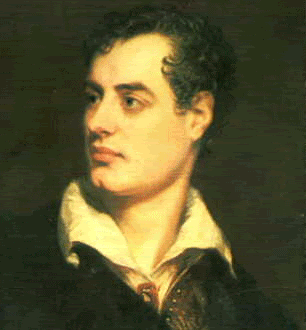
The Byronic Hero


The poet, Lord George Gordon Byron, walked the line between romanticism and satire. A contemporary and friend (even lover) of Gothic writers such as Mary Shelley, Byron's works reveal a fascination with dark romance. His characters effectively showcase these darker elements. The Byronic hero has come to be an accepted literary term for such characters. Byron's heros were idealized versions of himself, sharing many of the same traits that made Byron the larger than life, controversial figure that he was. These traits can be found in Bryron's works, such as in Giaour, Manfred, and Don Juan.

Angst. The Byronic hero is a conflicted individual. The character may suffer from guilt or obsession. This affliction gnaws at the soul. The hero is contemplative, introspective, and most of all brooding.

Rebellion. The Byronic hero is a rebel, casting off social norms. He has no regard for class, station, or authority. He defies the laws and customs of society, often acting with total disregard. Some actions may even be dangerous or criminal.

Sexuality. The Byronic hero is highly sexed, possibly being involved with multiple lovers. This sexuality tends to be socially unacceptable, such as sleeping with a married woman. Byron has even addressed the taboo of incest, homosexuality, and bisexuality. However, much of this has been buried by his publishers.

Charisma. The hero is charming, witty, and seductive. Words to him are like colors to a painter. Speaking is an art, it is poetry. An aloof character, when the hero does speak, his words carry power and influence.

Isolation. The Byronic hero is in exile, often caused by his failure to coexist peaceably in society. Occasionally this exile may be self imposed, as the hero sees himself as a potential threat, or thinks he is above petty and pedestrian concerns.

Intellect. The Byronic hero is well-educated. He possesses both book smarts and street smarts. The hero is quick to perceive and to understand. This intelligence may be the source of much of the hero's angst.

Confidence. Despite the turmoil and moral ambiguity the Byronic hero faces, he is confident, even smug, in his dealings. Whatever challenge he faces, he does so standing upright and stiff-lipped.

This list of traits is more indicative of an anti-hero. The elements of isolation, despair, and rebellion are not normally associated with heros. This shows the influence of play writers like Sophocles and Shakespeare. John Milton had a considerable influence over Byron's style of poetry, most obviously in the treatment, whether intentional or not, of Satan as a sympathetic character. Drama, particularly of a dark and romantic sort, colors the poems of Lord Byron.

This list of traits is also very close to the list of symptoms of an antisocial personality disorder. Cunning, confidence, isolation, sexuality, criminality, and charisma are all key indicators. However, what separates the Byronic hero from the run of the mill psychopath is the moral affliction. The Byronic hero feels a sense of remorse, sometimes quite deeply. This suggests a conscience, and an injured one at that.

Is is interesting to note that this conflict of conscience appears more often in Byron's heros than in the poet himself. Byron rebelled against social custom and status despite enjoying the benefits to being a wealthy lord. Byron had numerous affairs, yet dismissed his lovers once her grew bored of them. In short, he showed many traits of a sociopath. He was not a man to admit guilt or responsibility.

The model of the Byronic hero has been used throughout literary history since its inception. Byron's works have inspired authors like James Joyce to philosophers such as Friedrich Nietzsche. His heros helped to inspire our modern interpretation of the vampire. Byron's personal physician, Polidori, wrote a novel, The Vampire, based largely upon Lord Byron's life. Even the Batman possesses many traits of a Byronic hero, including heightened sexuality. In sum, the influence of Byron's dark and romantic characters cannot be dismissed. Indeed, these same traits are embraced by many in the gothic subculture of today.