Monday, March 15, 2010

On Satire

Satire is a means for making the ridiculous stand out, often by carrying an argument or opinion to the extreme. Although used primarily for comedic effect, the goal of satire is to expose some perceived evil, often that of an opposing viewpoint. Thus, satire often takes the form of a polemic. In some instances the satirist will assume the position of his or her opponent in the form of a parody. Parody proves effective if performed straight or as pantomime. However, although playing it straight adds gravitas, there is a danger of being take too seriously. Straight parody often goes over the heads of the more ignorant.

SATIRE ON THE STAGE
The pen of the playwright is often the tool for insurrection. Aristophanes, author of many of Ancient Greece's famed comedies, is regarded as one of the best satirists. In The Clouds Aristophanes turns his critical eye to philosophy. The plot involves an indebted father who enrolls his son in The Thinkery that he may learn rhetoric and defeat their accusers in court. A little knowledge is a dangerous thing, however. The boy learns instead to turn his back on social customs and moral behavior. Following an argument, the boy batters his father. Outraged, the father burns The Thinkery to the ground. Aristophanes portrayal of philosophers, Socrates in particular, was pointed out by Plato as one of the leading causes of Socrates' subsequent trial and death. Socrates indictment was that of corrupting the youth, an accusation that mirrors his character in the play.

SATIRE IN POETRY
Roman poets Horace and Juvenal are to satire what Plato and Aristotle are to philosophy. Horatian satire is light hearted, often poking fun at one's own vices. The goal is to provide insight in dealing with social problems. Juvenalian satire is often bitter. It is caustic in the way it shines a spotlight on some social ill. It seeks to ridicule. Satirical poetry had a considerable run during the 18th century with such poets as Dryden and Pope at the quill. John Dryden is famous for his mock-heroic satires, particularly MacFlecknoe, an attack on the poor literary sensibilities of his contemporary and rival, Thomas Shadwell. In a word, Dryden paints him as dull. Sadly, libel laws have nearly put an end to the polemic poem in England.

SATIRE IN ESSAY FORM
The direct and formal nature of the essay makes for a good polemic. Yet, because of the serious tone in most essays, satire in essay form is easily misconstrued. Take for instance Jonathan Swift's famous essay, A Modest Proposal. In it Swift suggests that to end poverty and starvation in Ireland you need to introduce but one policy, eat babies. In this regard, you cut down on the population, feed the starving, and cut costs of raising children. The number of complaints from people who took this seriously is staggering. In his essay, Swift meant only to bring attention to social ills. When writing a satirical essay it is perhaps best not to overestimate one's readers.

SATIRE IN FICTION
The novel and the short story present ways an author can introduce satire in narrative form. Children's literature, strangely, serves as one of the best options. Carrol's Alice in Wonderland and Through the Looking Glass contain several elements of satire. If one looks as the red and white chess pieces as political figures, the satire comes through. The Red King and Red Queen represent conservatives. They are combative and accusatory, the Red Queen often shouting, "Off with her head!" This iron grip and war like attitude is typical of republicans. Then you have the White King and White Queen that represent liberals. The White Queen is anxious and flighty. She means well, but is utterly incompetent.

SATIRE IN SONG
For those who could not read or write, the song proved a welcome tool for satire. As such, satirical songs were prominent in the Middle Ages. However, even the literate lace songs with acerbic wit. Voltaire (the musician, not the philosopher) has written and performed many satirical songs. One of the most blatant and scathing is "Bomb New Jersey." Voltaire grew up in New Jersey and suffered the abuse of the many, ignorant people there. Being goth and having a hot girlfriend did not help matters. Voltaire takes revenge in this anthem. "God Thinks" addresses the hypocrisy of those who claim to know the wishes of God. "Mr. Irresponsible" is an attack on those who live with little regard for the environment.

SATIRE IN FILM
Parody plays well on film. The Marx Brothers and Charley Chaplin have used the Silver Screen to knock the legs out from under the haughty-taughty. The latter also displayed the life of the unemployed during the depression, characterized by his lovable, yet hapless tramp. The Great Dictator is Chaplin's attack on Hitler and Mussolini. When the film was made, they had no idea of the atrocities that had been committed against the Jews. In retrospect the tone of the film seems a bit light and frivolous.

SATIRE ON TELEVISION
The immediacy and the regularity of television makes it a good source for satire. From very early on the sketch comedy show, Saturday Night Live, offered comedy writers a timely shot at bad politics. Spoofing presidents has been a long standing tradition. SNL also features a fake news segment called "Weekend Update." The fake news banner has been taken up by Comedy Central in The Daily Show with Jon Stewart and The Colbert Report. In the Colbert Report, Stephen Colbert takes on a conservative persona, a construct of Fox News reporters Sean Hannity, Bill O'Reilly, and Glenn Beck. As parody, Stephen emulates their "journalistic" style, only going the next step into the ridiculous. Often he has no need to as whatever the originals may say need only be repeated, as it is already ridiculous.

Sunday, March 7, 2010

The Suit of Swords

So Saturday was a bit crap for me. Today less so. So what better way to commemorate a dark mood than a dark theme? In episode 30 of the InsideOutcast I touched briefly on the suit of swords in the tarot. The suit of swords in divination contain many of the least auspicious cards outside the major arcana. The minor arcana reflect several castes within society. The swords represent, of course, the military class. Less obviously, the suit of swords identify royalty. Conflict is the central theme of the suit. Each suit corresponds to on of the four elements, the swords corresponding to air. Each suit also corresponds to some aspect of human nature. Swords reflect cognition. The appearance of a sword card in a reading could indicate some mental process. In the Osho Zen Tarot, swords are replaced with clouds. Clouds, like thoughts, are fleeting. They may darken your day, but will blow away over time. In the WIlliam Blake Tarot, swords are swapped for the suit of science. Science uncompromisingly displays the thought process. And with the general information now out of the way, let us consider the individual cards.

THE ACE OF SWORDS
By far the most positive of the sword cards is the ace. The ace of swords suggests action and initiative, like the drawing of a sword. Other meanings include mental acumen, a resolution to a problem, fairness in dealings, and uncovering the truth.

TWO OF SWORDS
When two swords cross, you have a stalemate. Evenly matched, neither dares make the first move. When progress is blocked so, too, is the path to truth. When faced with an opponent on equal terms, one shows no emotion lest it belie one's true intent.

THREE OF SWORDS
Three is a crowd. When three gather, surely two will engage in conversation leaving out the third. As such, this card embodies loneliness, heartbreak, and betrayal. The betrayal aspect can go either way, suggesting the subject of the reading may be a traitor.

FOUR OF SWORDS
Four is a lovely and sound, Greek number. It is uniform and solid as a square. This mathematical harmony finds its way into the meaning of this card. The four of swords is one of the few positive meanings, a period of repose. In U.S. Military terms, the four of swords suggests a period of R and R, rest and relaxation. It also reflects a time of quiet reflection and preparation.

FIVE OF SWORDS
The fifth in the series is like the second, only more complicated. The card suggests discord. In a military sense, the card reflects dishonor. In a more general sense, the five of swords suggests the very worst of acting in one's own self-interest.

SIX OF SWORDS
The sixth card usually has a neutral meaning, one of travel. If there is a negative connotation, it is one of the sadness at departure. In a positive sense, the six of swords can mean a recovery, particularly from injury, illness, or some other trauma. The meaning of this card depends greatly on the nature of the reading and the influence of the other cards.

SEVEN OF SWORDS
The seventh card is another that reflects the military nature of the suit. Seven of swords suggests cowardice, more specifically that of abandoning one's post. In a broader sense, the card illustrates the shirking of responsibility or the abandonment of a project. Other meanings include independence and isolation or acts of deception.

EIGHT OF SWORDS
The eighth card suggests impotence. The general meaning is one of powerlessness, a feeling of being restricted or oppressed. Often the card depicts a damsel blindfolded and tied to a mast or a stake, surrounded by eight swords.

NINE OF SWORDS
The ninth card illustrates the mental aspect of the suit. Doubt, worry, anguish, and guilt are the grim phantoms of the mind. The mind can be the greatest enemy, a host for anxiety and depression. In truth, mental stress only adds insult to injury.

TEN OF SWORDS
The tenth card is by far the least auspicious, suggesting desolation. Loss it total, defeat absolute. In this situation it is only natural that one feel sorry for oneself, that one feel victimized. However, there is one positive spin of the ten of swords, when you have lost everything there is nothing left to lose. Any change will be an improvement.

The royalty cards generally reflect actual people in a reading. The suit of swords indicate people of fair hair and light colored eyes. In a sense, caucasians with with blonde hair and blue eyes. As always, the suggested meaning does not always fit, so one must use judgement in determining the correct divination. There are four royal cards in each suit, each illustrating different characteristics. Multiple royal cards form pairs, illustrating relationships or doubling the influence of a certain aspect.

THE PAGE OF SWORDS
The page is often a young child or someone less experienced. Frequently the page is viewed as feminine. The page of swords represents a messenger, an envoy. Like the pages of old, she brings word of a challenge. The page is honest, analytical, forthright, and dependent. Just beware as news of any kind rarely bodes well.

THE KNIGHT OF SWORDS
The knight most often reflects a young, adult male - a teenager. The knight of swords represents direction, movement, and penetration. Depicted as a knight atop a charging horse, the card suggests sense of purpose and progression. This knight embodies the aspects of the sword. He is unfeeling, directed, uncompromising, adept, and precise.

THE QUEEN OF SWORDS
The queen is a woman of maturity. The queen of swords is usually depicted as a widow. She holds the truth above all else. As such, she has no patience for lies and no tolerance for deceivers. This queen has a sharp wit, a bright mind, and a clarity of judgement. She has a way of rooting out fools and cutting through the flak.

THE KING OF SWORDS
The king is a man of experience. The royal aspect of the suit is clear. This king reflects positive and broad sweeping influence. He is wise, fair, and eloquent. The king of swords brings order to chaos and makes sense of nonsense. He embodies those elements we regard as kingly.

Saturday, February 27, 2010

The Rectangle

Nature abhors a straight line.

Look at the natural world. The horizon is a curve. The limbs of the trees are crooked and gnarled. The river snakes through the canyon. Natural shapes are organic. They are irregular.

The manufactured world is not so much. Observe in the man made world the rectangle, perhaps the most commonly found shape. Not only your collections of books, but the bookcase as well is a rectangle. The cases containing your DVDs, the pictures and the frames on your wall, the wall itself are rectangles. Your chest of drawers, the drawers in your chest of drawers, the decorative carpentry on the drawers of your chest of drawers are rectangles. Our world is in many ways defined by the rectangle. In construction we have the 2x4. At the office we have 8 and 1/2 by 11 inch paper. Envelopes, mailboxes, filling cabinets, mailing labels, credit cards, windows, doors, boxes, laptops are all rectangles.

Why is the rectangle so common in the artificial world? In geometry, the rectangle is a simple shape composed of right angles. This simplicity makes the math involved equally simple. Want to know how much carpet you need to cover your living room? Take the length and multiply the width and there you go. Ever try to stack spheres? Doesn't work. Stacking boxes is much easier. How about fitting a curved door on a residential home? Only if it is custom built.

There is a reason people say to you "think out of the box." We live in boxes. Our homes are boxes. Our apartments are boxes within boxes. Our rooms are boxes within boxes within boxes. To think outside the norm is to leave conventional thought behind. What is more conventional than a box?

So what has nature against mathematical simplicity? Well, nothing really. Nature simply has its own math and its own simplicity. But nature prefers arcs and curves. In feng shui, the dragon of the earth, that is the flow of healthy chi, travels in arcs, not lines. A clean flow of chi requires slopes and rolling hills. Experts in feng shui rearrange furnishings to soften the hard, sharp corners of these rectangular homes. Chi, when not flowing well, is known as sha. Sha is destructive, harmful chi. It follows straight lines. While chi is meandering, sha is direct. Do you live at the end of a busy street? All that sha energy from the traffic on that street is directed at your house. Long exposure to sha can lead to restless sleep, increased stress, and health issues.

So don't just think outside the box, occasionally live outside it as well. Remember, even a coffin is a sort of box.

Sunday, February 21, 2010

Persona

We live as actors, putting on a role for each audience we encounter. At work we are professional. At home we are relaxed. With friends we are entertaining. With lovers we are passionate and/or vulnerable. We have a mask for every setting.

Persona is confronted directly in the rock performance troupe, Blue Man Group. The Complex explores the affect persona has on the individual. In order to assimilate into society, the individual surrenders elements of individuality. Going to work, we put on our mask. In the video, this is represented by a welding mask. Everyone wears this mask, each person undistinguished from the next. In truth, the person dissolves into the role. Think of how you treat your mechanic, your plumber, your waiter, your doctor. The clothes make the man, but the uniform makes the employee. A pocket protector says volumes as does a name tag.

This metaphor is explored further. The shadows cast by the masked masses resemble the stylized characters posted on the rest room door. The image, displayed boldly on the album cover, is one of a person stripped completely of any defining characteristics. In a word, a person becomes generic.

In our lives, we are very much in danger of getting absorbed into our roles. How many of us define ourselves by what we do? Who are you? I'm a lawyer. I'm a student. I'm a pediatrician. Who answers with I am a man who enjoys a quiet moment? I am a woman who appreciates a good action sequence in a film. Who we are is greater than what we do. Our hopes, our dreams, our loves, our hates define us just as much - if not more than - what we do.

In Blue Man Group's show, the masked nobody finally peels away the layers of persona. Shrugging off the conventions, the individual "takes the fire escape up to the roof" instead of using the stairs like everyone else. In an increasingly small world, one must retain some sense of self. Keep to the center. Know thyself.

Saturday, February 13, 2010

Jungian Pooh

As promised, I present the personalities of the characters in A.A. Milne's classic, Winnie the Pooh. I am not the first to compare the inhabitants of the 100 Acre Wood with modern personality types. The Tao of Pooh and The Te of Piglet by Benjamin Hoff does this quite well. This is not a stretch, however. Clearly each animal is meant to represent some Jungian archetype. Here I shall list the character, his or her traits, and the modern equivalent.

Eeyore
The blue donkey known as Eeyore is blue for a reason. Eeyore is the epitome of apathy, dispassion, listlessness, and depression. The somber Eeyore is a pessimist. He lives in a simple shelter of a number of piled together sticks. Why? Because that is the best he can hope to get. He falls in a stream and floats and floats, never struggling to make his way to the bank. He waits for someone to help him out - just as long as it is no bother. His unwillingness to provide for himself coupled with the passive-aggressive manner are the main traits of this mournful quadraped. Nevertheless, many of us love Eeyore dearly. Why? Because the little Donkey that couldn't appeals to our own melancholy.

Learned helplessness is the psychological basis behind apathy. Repeated failure leads to no longer trying. If a dog is placed on an electrified floor and has no means of escape, it has little choice but to lament the situation. Repeated experiences in this electrified room conditions the dog to this state of being. One day, when a partition is removed to allow the canine and escape from discomfort, the dog does not take the opportunity. Experience has proven that escape is impossible. Why should this time be any different.

So it is with man. Repeated failure conditions us to anticipate failure. Like Eeyore, we do not strive as hard as we should. We do not swim for the bank of the river. When we accept failure as the only outcome, an attempt to change the situation seems futile. Why bother? As such, many of us remain in a less than desirable position simply because no other option presents itself - or so we think. The pessimist does not bother hoping for the best, let alone taking action to improve things.

That is not to say the Eeyore personality is joyless. The pessimist can find value in the small things, in consistency and routine. Even isolation can provide solace for the blue. Eeyore does not seek to be with his friends. If they come by, fine. So much for misery loving company.

Gopher
Gopher is not a very popular character. The blind, gruffy rodent is an industrious sort. He is known to be digging his tunnels into which other characters occasionally fall. Gopher did not appear in the storybook. he is an invention of Disney, based primarily on the beaver from Lady and the Tramp. Gopher typically whistles through his teeth as he speaks. He also has very poor eyesight.

Gopher represents the older generation, primarily the veteran generation. Those that experienced WWII and/or lived through the great depression have a strong work ethic. They are stern, no nonsense people with a strong moral center. It is clear that gopher is meant to be older. Furthermore, Gopher spends most of his life underground. Much like older generations hole up in their homes, are wary of new technology and recent trends, and the like - Gopher's existence underground and in the dark is more literal than symbolic.

Despite unfamiliarity with current trends, the older generation has experience. Gopher's experience often comes in useful. Wisdom, too, is an asset of the older generation. Gopher embraces this dichotomy of wisdom and experience and contemporary ineptitude and conditions of age.

Kanga
Kanga is the only female character in the storybooks. As mother to Roo, she embraces the aspects of motherhood and femininity. She is affectionate and protective. Though not very educated, she is naturally inclined to do the best for her son and by extension her friends. Later, she welcomes Roo's friend, Tigger, into their home.

Clearly Kanga is the archetypical woman, combining elements of the Empress and the Priestess from the tarot. In one respect, she is mother and protector. The matron of 100 Acre Wood, Kanga is the primary caregiver. Meanwhile, she incorporates women's intuition, that knowing without knowing. She knows when there is trouble, when her son is in danger. She also knows when someone is playing a joke on her.

Owl
Owl is a bespectacled bird living in a stately home high up in a tree. Owl is educated, or so he thinks. He is able to read and write, almost. He is quick to advice, instruction, and anecdotes regarding distant family members. Owl explicitly embodies the archetype of the educator. He is an academic.

Academia is under the illusion that it is providing young minds with the assets necessary in surviving the work a day world. However, real life is often worlds apart from the class room. The teacher is often removed from reality, living in an ivory tower of textbooks and chemistry sets. That is not all. A little knowledge is a dangerous thing. Armed with half the facts, the academic is prone to fill in the blanks with supposition. That owl assumes Piglets home is his own is such a leap to conclusions.

Owl is quick to state some meaningless fact, which typically is false or only half true. I, too, find that I offer facts, opinions, advice, etc. a little too freely. There is something owl like in my manner. Even this blog has the mark of the owl. A bit preachy, a bit self-aggrandizing, a bit pedantic.

Piglet
Piglet is Pooh Bear's very best friend. He is very small and knows this to be true. His small stature makes him timid and meek. He is fearful, even of his own shadow. Yet, he has a big heart.

The funny thing about those of a nervous disposition, those that jump at shadows, is that when a real crises presents itself, often they overcome fear. It is as though the truly frightening is beyond their capacity. Those that jump at the shadow of a beast when confronted with a beast do not jump. In the Te of Piglet, Hoff expounds on the virtues of the small, the integrity of piglet. He is righteous in a nonjudgmental fashion, he is brave when courage is required, he is loyal when friends are troubled.

Piglet has many qualities I admire, and by extension those qualities I find in people. Humility, compassion, caution, loyalty. These traits make up a good friend.

Rabbit
As discussed in the podcast, Rabbit is the least liked of the inhabitants of 100 Acre Wood. Rabbit can be summed up in one word, stress. He places an exorbitant importance on things. He guards his garden from Tigger and Gopher. He protects his honey from Pooh. We fails to grasp the concept of sharing, the enjoyment to be had by giving to friends. Simply, he cannot let go.

We are familiar with the type, the workaholics, the micromanagers. Those who place too much importance on things, on routines, on the destination and not the journey will only find dismay. The four noble truths of Buddhism state that 1) life is suffering and that 2) suffering comes from attachment. Attachment is the process of identifying ourselves with objects, in a sense actual objects of desire. Cars, yachts, houses, clothing, electronics, anything that can be consumed. These are fragile things with no real value outside that we attach to it. By strapping our sense of self to these objects, our ego, too, is just as fragile and hollow.

The Rabbit personality claims to own things, but they really own him. Consider how much time he spends in his garden. If he only knew that gardens naturally grow.

Roo
The sun of Kanga, Roo is the embodiment of child like innocence. A friend of Tigger and Piglet, Roo is playful, with that spirit of adventure that most boys have. He balances Piglet, as he draws the gentle pig out of his comfort zone. He balances Tigger as, though found of activity, Roo is more responsible.

Back to the tarot, the first card, the 0 card, is The Fool. The Fool represents child like innocence and that sense of adventure. The Fool is fearless, as all young boys tend to be. Death cannot touch him. The Fool is an optimist as well, with eyes fixed on the distant horizon and not the dangerous precipice before him. Roo, and children like Roo, carry this spirit in their hearts. Some maintain this adventurous spirit into adulthood, becoming test pilots, explorers, astronauts.

Tigger
Nearly everyone's favorite character, usually with the exception of Pooh, is Tigger. Tigger is bold, brash, exuberant, friendly, outgoing. He embodies those traits that make one popular. He seems entertaining, certainly fun at parties. And Tigger means well. There is no question that he appreciates having friends. He is the very epitome of the extrovert.

However, there is a down side to Tigger. Consider if you would like Tigger as much if he were real and an actual friend. Where ever he goes, he leaves a trail of destruction like a tornado. He is a whirlwind of activity. One is reminded of either someone with Attention Deficit Disorder or a major sugar high (or some other stimulant). Life with a Tigger personality, though exciting, is also exhausting. Tigger types love life, and seek to squeeze every drop of enjoyment from life. Sadly, this often leaves everyone around them drained.

Tigger types, though lovable, are best experienced in small doses.

Winnie the Pooh
The bear of very simple brain, Winnie the Pooh, is a strange archetype for a hero. He is absolutely without guile. If he comes to your house, he willingly admits that he has come for a jar of honey. True, he may engage in some pleasant conversation as well, but his motives are there on the table. He is by no means a thinker, he is not even that much of a doer. He just is.

In the Tao of Pooh, Hoff compares these qualities with those of the Daoist sage. The goal of Daoist path is to return to simplicity. When your only concerns are food and sleep, then you have stripped away all the extraneous detritus from your life and are just that closer to wuji - the state of formlessness comparable to nirvana.

Pooh is what he is. Sadly this is looked down upon in our society. A lack of ambition is viewed as laziness. Honestly is regarded as crude and blunt. Simplicity in speech and manner is deemed unsophisticated to downright stupid.

Yet Pooh Bear forms the hub of this circle of friends. Each knows what they may expect of Pooh. Pooh has no hidden agenda. Even Rabbit tolerates Pooh to some degree, setting aside a few jars of honey for when the gentle bear drops by.

So, there you have it. The personalities of the characters devised by A.A. Milne as compared to our own personality archetypes. Which are you? Well, I think each, even Rabbit, reside in our hearts. That we feel a certain way about each reflects on how we view those separate elements of our psyche. That I find my knack for pedantry an embarrassment, yet regard my timidity with less disdain directly correlates with how I view Owl and Piglet.

Sunday, February 7, 2010

Grandmaster Flash: The Original DJ

In the podcast, I mentioned Dee-Lite and Fatboy Slim as major breakthrough artists from the DJ culture. In doing so I meant to illustrate how DJs have been embraced by the mainstream. However, they are by no means the first. Samples have been used in music for a long time.

Hip Hop originators, Grandmaster Flash and the Furious Five, developed the DJ style we know of today. Grandmaster Flash had a fascination with recorded music from a young age. His father collected record albums. Joseph Sandler, Grandmaster Flash, understandably grew curious as his father protected his records and the phonograph. There is nothing that leads to obsession quite like that which is off limits. When he had the chance, he broke the rules and investigated this musical wonder. He was intrigued by the music that "lived in the tunnels" of a vinyl record. Through experimentation, he discovered how music was formed through the vibrations transmitted from the groove, to the needle, and into the electronic gizmos within the phonograph. He discovered also that his own hand could silence, slow, or speed up a track - even reverse it. He even figured out how to reduce drag on the turntable.

Up to this point, records were treated like China dolls. DJs wore gloves and touched the platter only by the sides. They laid the record gently on the turntable, gave it a brush off, and played it respectfully. Grandmaster Flash, on the other hand, had a more hands on approach. This hands on technique developed further and further. Eventually this developed into scratching, layering tracks, repeating beats and breaks, and the works.

So credit must go to the originators. Credit also must go to Big Audio Dynamites use of sampling, in their own right inspired by hip hop in the US. So, in the late 70s, hip hop came to the fore. In the 1980s, electro ran the clubs. In the 90s, big beat and electronica grew in popularity. In the 2000s, DJ culture showed no sign of stopping. The musical styles have grown and grown, diverging into new arenas. Former DJs are now musicians in their own right. Meanwhile, contemporary musicians in the goth-industrial scene DJ on the side.

It will be interesting, now that I follow many DJs, where it goes from here.

Saturday, January 30, 2010

Social Capital

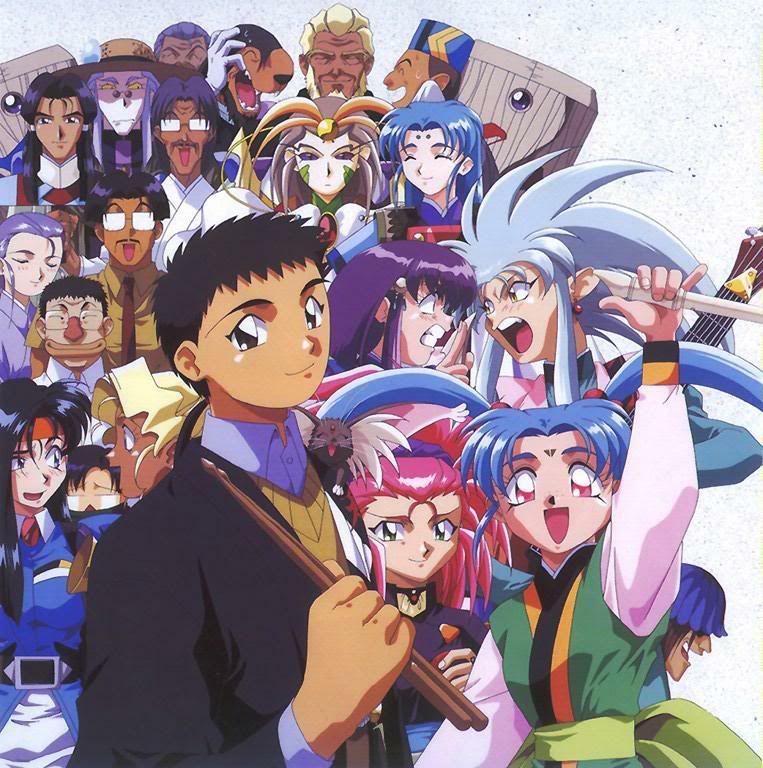
In our discussion of the Tenchi anime series, I mentioned how Tenchi formed the center of a web of different social groups. I compared this to twitter, other online social networks, and the more immediate connections we have with friends and family. Tenchi's first contact is his family. His father and grandfather - even his deceased mother - are his closest ties. Next is work and school - his obligations as a student and as a priest in training. After this, his connection with the various alien women that occupy his home.

Ryoko represents the wild side. A space pirate, she is bold, brash, immodest, crude. Mihoshi represents inexperience. A junior police officer, she is quick to emotions of happiness and sorrow. Ayeka represents tradition and high society. The first Princess of Jurai, she is wealthy, cultured, and haughty. Sasami represents childlike innocence. The second Princess of Jurai, she is honest, helpful, and without guile. Washu represents knowledge and skill. A renowned scientist, she is educated, curious, and inventive. Kiyone represents responsibility. A career police woman, she is meticulous, cautious, and frustrated.

Tenchi's relationship with each girl directly influences them in some way. Ryoko, usually very masculine in behavior, appears more feminine and vulnerable in his presence. Ayeka, normally of a composed demeanor, slips into fits of shameless infatuation and jealousy. The connection is stronger in some relationships than others, but each relationship affects both Tenchi and the girl in question to some degree. Furthermore, each girl influences not only Tenchi, but the other girls as well. Ayeka compares herself to Ryoko, thus confirming her social status. The Washu to Kiyone comparison is likewise clear, though less confrontational.

I have found on twitter that communities, or nodes, form around each profile. First, there were close friends and fellow members of the Legion of Tangent(.co.cc). Along with the Legion was, of course, my wife and fellow podcaster, Brandi. Through the course of tweeting I have met many people. I have met a number of bands, such as Twitch the Ripper and All My Faith Lost... Through the Gentlemen's Grindhouse podcast I have come into contact with several horror fans, bloggers, merchandisers, and podcasters. Furthermore, through TGG I met much of the rest of Geek Planet Online. I am known to tweet a great deal about music, and as such have made contact with several DJs, goths, record stores, and radio stations.

Each follower, for the most part, existed first as a separate entity. Then a small node formed around one profile or another. The InsideOutcast has a community of listeners as does Dark Horizons radio. Gradually, members of a node interacted with members of another. This may be due in part to Follow Friday, but is mostly through referencing other profiles in conversation. Horror fans met Sci Fi geeks, goths met rivetheads. Smaller nodes grew into larger ones as each overlapped with another.

That is not to say that twitter is a melting pot. If so, blocking would not be an option. Some nodes remain separate. Even still, the web is more intricate and broad than it may seem. What happens to one tweep can very well affect that entire node, for good or bad, and may even spread to other nodes. Hence many a trending topic. I know through my own tweets that I have had both positive and negative affects on individual tweeps as well as these communities of similar tweeps. Just recently I convinced a few members of one node to attend a live show at Digital Mindfield Radio. The IDM band, Bioassay, performed live from the house. This may lead to one node forming a stronger connection to another.

I, too, have been drawn into nodes, or rather, into a larger community. Dark Horizons is one such node. Theresa's Silly Question of the Week allowed me to access, through hashtags and mention of @DHRadio, other listeners. By doing this, I discovered tweeps with a similar taste in music, and by extension, a similar lifestyle.

But like Tenchi, the effect a relationship has on us directly correlates to the strength of the connection. Close friends and family have a greater impact on us than, say, a celebrity we happen to follow. Knowing when the next album drops is one thing, but discussing our personal lives is quite another. The celebrity cares little for our tweets. How can what we say matter when we are but 1 of 1,978,325 followers?

The value we hold in a social network is our social capital. Our influence may be stronger over one tweep than another. Furthermore, the tweets from one person may have greater influence over us. If the influence is mutual, then the value of social capital is even higher in that instance. Mutual respect in a relationship is preferred. It is one thing to be a teacher or a student, another to be a friend.

So I would like to thank my many twitter friends for the social capital bestowed on me. I hope not to piss away your investment in me. In the third series, Tenchi in Tokyo, Tenchi's power derives from the social capital, the connection, he has with the girls. The stronger their trust in him and love for him, the mightier he becomes. As defender of the Earth, that power is without price. I, however, am not a defender of the Earth as such. I do not carry a magical sword (yet). Just the same, it is comforting to know that someone out there holds me in esteem.