Saturday, October 31, 2009

The Evil Eye

Of all the causes of bad luck, people fear the evil eye most. The merest glance results in misfortune. One may wish ill upon the subject of his gaze, making the evil eye intentional. Often, though, the evil eye is more incidental than intentional. Simply by looking enviously at a subject, the viewer casts the evil eye. Envy is one of the seven cardinal sins. The evil of sin, magnified through the intensity of one's gaze, is directed, willingly or otherwise, at the source of that envy.

Certain persons are more inclined to possess the evil eye, and must be avoided if possible. Most with the evil eye are otherwise harmless. However, witches are suspected of possessing the evil eye along side other magical properties.

At risk of the evil eye are children, young women, and upstanding members of the community. Anyone that may cause envy in others can fall prey to the evil eye. The evil eye may befall you anytime you have a new child, get a new house, receive a promotion, etc. Objects of envy may be affected as well. Folklore has it that cattle are prone to the evil eye. Symptoms of the evil eye include misfortune, disease, and even death. Paralysis or loss of speech may result. So how does one protect oneself from such evil influence? Superstition suggests many precautions against the evil eye.

AMULETS & CHARMS - Jewelry especially designed to protect one from the evil eye are common in the areas of Greece and Turkey. In a case of fighting fire with fire, the charms predominantly display an eye motif. The eye is frequently blue in color and is set in silver or gold. Protection may be worn as earrings, rings, bracelets, or what have you. The Egyptian Eye of Horus is a strong symbol against the negative power of the evil eye. Other amulets may be in the form of stones, pieces of bone, wood, or shell. The Italian horn is a fine example of a charm.

DECORATIONS - A well placed charm or talisman in the home prevents misfortune resulting from the evil eye. The Chinese use of the bagua mirror, or feng shui in general, can greatly reduce or redirect evil energy. Even applying certain colored paint either in or out of doors fortifies the home against the curse.

EYEPATCHES - The evil-eyed can prevent the negative influence of their gaze by wearing a patch over the offending eye. Black is the color of choice.

GESTURES - Ritualized actions can counter the curse. Most frequently, the sign of the cross suffices to rid oneself of evil influence. Forming the devil's horns, a gesture now witnessed at most rock concerts, is another option.

HUMILITY - If one wishes to prevent instances of evil eye, it is advised to avoid making others jealous or spiteful. In China, superstitious parents give their children humble names as to not incur the wrath of the gods. Another option is to give a male cild a female name as to confuse the gods or demons. In the middle east, parents are quick to list the faults of their children so the evil-eyed will not direct their dreaded gaze. Parents may go so far as to leave their children unwashed and/or shabbily dressed.

SALIVA - Spitting, especially within gypsy culture, possesses anti-magical properties. Spitting in the palm of the hand in order to seal a deal is to ensure you are not making a deal with a witch or the devil. Spitting in a witch's cauldron is a pretty sure way to rob it of its magical properties. Therefore, it stands to reason that spitting would have a similar effect against the evil eye. Spitting over the shoulder to counter a curse is displayed as far as China. As the left side is the sinister one, spitting over the left shoulder is preferred. Spitting is generally a last resort.

SPELLS - Many cultures employ spoken word defenses to the evil eye. By reciting magical phrases, one counteracts the negative power of the evil eye. Invoking God is a common defensive spell in Ireland. "God Bless," is a versatile tool to counteract most instances of the evil eye.

Although belief in the evil eye is more common to country folk and the less developed countries, it is surprising how many of us still believe in luck. The world we live in is increasingly secular. Science views the world through cold, analytical eyes. Everything is quantifiable, measurable, categorical. Yet, many believe in some invisible force, whether God, chi, karma, or what have you. Something influences our lives, making us more or less successful, healthy, or content. There are various ways one can defend a belief in luck.

Anthropologically speaking, the belief in superstition and the practice of ritual maintains cultural trends. Crossing oneself, spitting, wearing charms, these are perpetuations of a myth. These practices root man's place in the universe.

Psychologically speaking, the belief in luck can positively or negatively affect one's performance. Lucky individuals are more likely to succeed in that they have greater confidence. The power does not come from some lucky penny or shirt, but from that individual's belief. On the other hand, those who think themselves unlucky make themselves more subject to failure. In a very real sense, one makes one's own luck.

According to quantum mechanics, the attitude of the observer may affect objects at a sub-atomic level. How matter manifests within the probability field is determined by the observer's perspective. Should that perspective be positive, the object observed should reflect that positivity. In this instance, the power of the evil eye is very real. By looking at something with envy, hate, or spite, that object is manifested with negative aspects.

So whether or not you believe in the evil eye, or in luck in general, there is no denying the power of the evil eye throughout human history. Belief in the negative power of envy and hate, an in its influence over the innocent, is a part of our heritage.


Sunday, October 25, 2009

The Christians Who Stole Christmas

As Christianity spread out into the pagan regions of Europe, mainly the British Isles, it assimilated the traditions of those pagan religions in order to better compel the people to join. As long as people celebrated the same festivals during the same time of year, what did it matter what God they worshipped? There are two major Christian Holidays that borrow freely from pagan tradition, Easter and Christmas.

Easter, or Ostara, was originally took place during the Spring equinox with festivals to celebrate fertility and rebirth. As the crops grow, and the livestock breed, there is a promise of bounty. This translates to interpersonal relationships as well, the "Spring Fever" that comes over the young. Love and sexuality are very much part and parcel with this time of year. The pagan traditions illustrate this. The may pole is a phallic symbol, a monument of masculine generative power. The egg, painted or not, is a more feminine symbol of generative power. Moreover, the egg is a symbol of immortality. The chicken hatches from an egg, grows old, and then lays an egg. The easter dress, too, suggests a kind of rebirth. By donning a new outfit, young girls are transformed, shedding the old skin. The easter bunny embodies the spirit of Ostara. Rabbits are known for their accelerated rate of multiplication. The bunny is a symbol of sexuality, fertility, and bounty.

Christians adopted, or rather permitted, the continued celebrations of eggs and bunnies. However, instead of being a celebration of fertility, Easter is to acknowledge the resurrection of Christ. Just as vegetation grows once more after the winter thaw, Jesus rises from the dead. Rebirth is the focus. Few Christians look too closely at the deeper meaning of these traditions.

Christmas, or Yule, originally took place during the winter solstice to celebrate the return of the light. Taking place during the shortest day of the year, Yule celebrates not only surviving the worst of winter, but embracing the coming spring. Christmas goes as far back as ancient Rome and the worship of the god, Mythras. Though little is known about this god, there is some suggestion that Mythras may be a divine representative of the sun. A festival to embrace the return of the sun on the winter solstice is self-evident. Christianity adopting this holiday is equally self-explanatory. Celebrating the coming sun, or the return of light and celebrating the birth of the son (sun) of God are very similar. Take for instance the star of Bethlehem, a guiding light in the darkness. The burning of candles or a Yule log is a symbolic gesture emulating the return of the sun. One may go so far as to equate the pagan belief in fairies with the Christian belief in angels, another symbol of Christmas.

Other Christmas traditions borrow heavily from Druidism, namely the fir tree, holly, mistletoe, and wreaths. Mistletoe was used by druids for magical, healing purposes. It is also a symbol of peace. Holly is a particularly hard wood that was used for carvings and as winter fodder. The wreath is a circle woven of the branches of evergreen. The wreath goes as far back as ancient greece and the worship of Apollo, another sun god. Meanwhile, the fir is yet another evergreen, suggesting survival throughout the winter.

Of the pagan holidays, Halloween or Samhain, has remained relativity untouched by Christian hands. Mexico has the Day of the Dead and there is All Saints Day, but worship has not overwhelmed the traditions of Halloween. Halloween comes at the Autumnal equinox and is in one part a harvest festival, and in another part a protection ritual at the start of the dark half of the year. During this time, it was believed the veil between the living and the dead worlds grew thin. The dead and evil spirits could cross over into the mortal realm. By donning fearsome images, the average person could protect themselves as the evil spirits would see them as one of their own. Jack-o-lanterns, an Irish tradition, came later as another means of dealing with nasty spirits.

So far these traditions have been regarded as pagan, and though often tolerated by most Christian groups, they have yet to be embraced but in the case of a couple of instances.

Sunday, October 18, 2009

The Big Bad Wolf: A Short Treatise

So why the wolf? Why should the aspect of the wolf so dominate our folklore, literature, art, and dreams? Well, of all the wild and predatory beasts, the wolf is the most likely to come into contact with the average person, in Europe anyway. Since the wolf has been known to claim the easy prey that is domesticated livestock, man has come to be at odds with the creature. As such, the wolf represents avarice, impulse, wildness, ferocity, and mystique. The wolf possesses a noble - if wild - beauty, so themes of seduction and sensuality also may apply to the wolf.

No figure in society represents the Jungian archetype of this creature more fittingly than the Big Bad Wolf. A staple of the fairy tale, the wolf embodies the wildness in nature and, therefore, the darker half of ourselves.

Early use of the wolf archetype was used primarily for morality tales. The boy who cried wolf illustrates the dangers of lying. He alerts the village to the presence of a wolf so that the townsfolk run out of doors in a panic. A cheap laugh to say the least. However, the prank wears thin. When an actual wolf slinks into the town, the boy cries, "Wolf!" Yet no one comes out of doors. The wolf promptly eats him.

The Three Little Pigs is another morality tale, this time focusing on the importance of industry. The brother pigs decide to build homes for themselves. The first pig is the most lazy He builds his home of straw. The second brother is not quite as lazy. He builds his of clay. The final pig is the most industrious. He builds his of stone and mortar. A wolf comes to the first brother, demanding to be let in. The pig refuses. So, the wolf takes in a deep breath and blows down the house of straw. The pig escapes to the house of clay. Again, the wolf demands to be let in. The two pigs refuse. Again, the wolf blows the house down. The two brothers escape to the house of stone. Here the wolf comes to an impasse. No matter how hard he bellows, the house stands. Exhausted, the wolf is easily defeated.

Early stories of Little Red Riding Hood instruct young women to beware of strangers. In traveling to her grandmother's house, the young lady encounters a wolf. He is charming and polite, asking to have what is inside the young miss's basket. She refuses, claiming that the baked goods are for her grandmother. The wolf, now made aware of the maiden's destination. makes haste to the grandmother's house. There, he eats the grandmother, dresses in her clothing, and waits. When Little Red Riding Hood arrives, the wolf masquerades as the grandmother and consumes our poor heroine. In the early tale no woodsman comes to her rescue. Even then the world was a dangerous place for young ladies. Parents made them aware of the dangers of speaking to strangers.

However, there are several sides to Little Red Riding Hood. The latent sexuality of the faery tale is well-nigh blatant according to modern sensibilities. The red hood has several intonations. For one, the hood represents the maidenhead. An intact hymen is a symbol of virginity. The red color signifies blood. The hymen has been torn. Conversely, a red hood was the choice article of clothing for prostitutes in France. So, the character of Little Red Riding Hood represents a sexualized, or soon to be, woman. The wolf, on the other hand, represents the male, sexual predator. He is charming and sly. He is persistent, appearing to the girl several times along her way, each time trying to persuade her. At the end, he takes drastic measures and meets her at her destination. There, he assault her. He ravishes her. He 'sinks his fangs' into her.

There are less sexual themes. One interpretation is that Red's encounter with the wolf and later consumption and restoration is a symbolic representation of puberty. The wolf represents the change. Not only is he furry, but he is a natural phenomenon and is linked with the moon. The red hood, then, could very well refer to menstruation.

Whatever ones take on the faery tale, and no matter how innocent our interpretation of it, Little Red Riding Hood remains a compelling story and a stone in the firmament of folklore. Its influence is widespread. The story has seen many retellings and re-imaginings. From Perrault to Angela Carter, from cartoons to pornography, the key points of the story are left unaltered. A young woman encounters a creature that dupes her into giving up something precious, possibly her life.

Red has been represented as an innocent young lady to Tex Avery's animated showgirl. The wolves in the latter could be seen hanging around the corner of Hollywood and Vine. Clearly this modern reference captures the sexual and predatory nature of men. The Big Bad Wolf has gone on to inspire many werewolf and related stories. The Strange Case of Dr. Jekkyl and Mr. Hyde is an example of the wildness of the wolf internalized rather than externalized.

Although the wolf is in itself a noble and majestic creature, the image of the Big Bad Wolf is a part of our cultural history. Wolves will continue to be regarded as dangerous, and their images and aspects represented as such in many tales to come.

Friday, October 9, 2009

The Byronic Hero


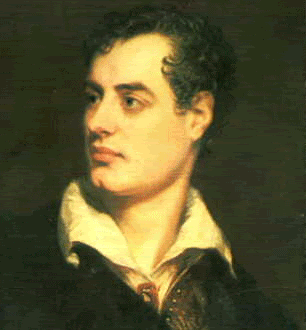
The poet, Lord George Gordon Byron, walked the line between romanticism and satire. A contemporary and friend (even lover) of Gothic writers such as Mary Shelley, Byron's works reveal a fascination with dark romance. His characters effectively showcase these darker elements. The Byronic hero has come to be an accepted literary term for such characters. Byron's heros were idealized versions of himself, sharing many of the same traits that made Byron the larger than life, controversial figure that he was. These traits can be found in Bryron's works, such as in Giaour, Manfred, and Don Juan.

Angst. The Byronic hero is a conflicted individual. The character may suffer from guilt or obsession. This affliction gnaws at the soul. The hero is contemplative, introspective, and most of all brooding.

Rebellion. The Byronic hero is a rebel, casting off social norms. He has no regard for class, station, or authority. He defies the laws and customs of society, often acting with total disregard. Some actions may even be dangerous or criminal.

Sexuality. The Byronic hero is highly sexed, possibly being involved with multiple lovers. This sexuality tends to be socially unacceptable, such as sleeping with a married woman. Byron has even addressed the taboo of incest, homosexuality, and bisexuality. However, much of this has been buried by his publishers.

Charisma. The hero is charming, witty, and seductive. Words to him are like colors to a painter. Speaking is an art, it is poetry. An aloof character, when the hero does speak, his words carry power and influence.

Isolation. The Byronic hero is in exile, often caused by his failure to coexist peaceably in society. Occasionally this exile may be self imposed, as the hero sees himself as a potential threat, or thinks he is above petty and pedestrian concerns.

Intellect. The Byronic hero is well-educated. He possesses both book smarts and street smarts. The hero is quick to perceive and to understand. This intelligence may be the source of much of the hero's angst.

Confidence. Despite the turmoil and moral ambiguity the Byronic hero faces, he is confident, even smug, in his dealings. Whatever challenge he faces, he does so standing upright and stiff-lipped.

This list of traits is more indicative of an anti-hero. The elements of isolation, despair, and rebellion are not normally associated with heros. This shows the influence of play writers like Sophocles and Shakespeare. John Milton had a considerable influence over Byron's style of poetry, most obviously in the treatment, whether intentional or not, of Satan as a sympathetic character. Drama, particularly of a dark and romantic sort, colors the poems of Lord Byron.

This list of traits is also very close to the list of symptoms of an antisocial personality disorder. Cunning, confidence, isolation, sexuality, criminality, and charisma are all key indicators. However, what separates the Byronic hero from the run of the mill psychopath is the moral affliction. The Byronic hero feels a sense of remorse, sometimes quite deeply. This suggests a conscience, and an injured one at that.

Is is interesting to note that this conflict of conscience appears more often in Byron's heros than in the poet himself. Byron rebelled against social custom and status despite enjoying the benefits to being a wealthy lord. Byron had numerous affairs, yet dismissed his lovers once her grew bored of them. In short, he showed many traits of a sociopath. He was not a man to admit guilt or responsibility.

The model of the Byronic hero has been used throughout literary history since its inception. Byron's works have inspired authors like James Joyce to philosophers such as Friedrich Nietzsche. His heros helped to inspire our modern interpretation of the vampire. Byron's personal physician, Polidori, wrote a novel, The Vampire, based largely upon Lord Byron's life. Even the Batman possesses many traits of a Byronic hero, including heightened sexuality. In sum, the influence of Byron's dark and romantic characters cannot be dismissed. Indeed, these same traits are embraced by many in the gothic subculture of today.


Friday, October 2, 2009

Hanging Ghosts

In Chinese folklore, a hanging ghost is the spirit of a departed person that remains on the realm between heaven and earth due to some trauma. Often the ghost is the spirit of a murdered person, or a fallen soldier. However, spirits of persons that have committed suicide may become hanging ghosts as well as any person that has suffered dishonor. Since suicide in Asian culture is recognized as an acceptable way to deal with dishonor, this ghost appears frequently in Chinese art, music, and literature.

The hanging ghost remains behind due to some unfulfilled prospect or desire. In a culture of ancestor worship, the hanging ghost lends focus on a slight to the family name that must be remedied. It falls to the surviving members of the family to remove this stain, including the fulfillment of the task given the deceased ancestor, or avenging that ancestor's death. Once the task is fulfilled, the spirit of the ancestor can rest, in which case it watches over and protects the family.

However, not all ghosts are so cut and dry. Hanging ghosts that are ignored by the family, or have no one to act on their behalf, grow upset or are driven mad. A disgruntled ghost can be cause for alarm, haunting a location or even possessing individuals. Ghosts can cause crops to die, can expose a village to disease, and can generally cause a bit of a ruckus. In this instance, the village, family, or individual calls upon a Daoist wizard.

Magical Daoism, aside from Daoist knowledge, combines elements of Buddhism and Chinese folk religion. The Daoist sorcerer utilizes these skills in dealing with an upset or wayward spirit. There are several tools at the sorcerer's disposal. He may simply frighten the spirit away with charms, talismans, and mystic mirrors, however this is only a quick fix, and the spirit will likely return. Warding off the ghost temporarily provides the opportunity to develop other strategies.

For instance, the sorcerer can trap the spirit in anything from a gourd to a net. Even bags and jars prove a handy vessel with which to imprison an angry ghost. Once trapped, the sorcerer can lead the spirit away and release it to the underworld/afterlife. Usually this is an enchanted cave.

Part of trapping a spirit is freezing one in place. To shock a spirit into stopping, the sorcerer often uses a ceremonial sword (frequently made of coins). An intricate dance lures the spirit within striking distance. A sword anointed in charms and the sorcerer's own blood will shock the spirit when stabbed. Other methods include throwing dog urine at the spirit. Once bound, the sorcerer can imprison it, reason with it, or bribe it into leaving or changing its ways. Bribing can be in the shape of ceremonial money or other gifts. Such symbolic gifts of ghost money are made at the funeral of a family member to better ensure the satisfaction and social status of the departed.

The final resort in dealing with a hanging ghost is to dissipate the spirit. This could prove necessary if the spirit is particularly troublesome. To rid of a spirit so that it will never manifest again requires the sorcerer to call upon divine support. Generally he calls upon warrior gods, but other gods may prove helpful if the spirit is rather clever. To achieve this, the sorcerer performs a number of mudras, or mystical hand gestures derived from Tibet. He also speaks several words of power. The invoked gods enter combat with the troublesome spirit and overwhelm it.

It should be noted that the Chinese are quite practical when it comes to gods and the supernatural. Hanging ghosts, or ghosts in general, can prove quite useful. If sailors pray to the spirit of a drowned girl and it appears to protect them, the divinity of the drowned girl increases in status. Ancestor ghosts may become immortals, then officials, then deities. If the god one prays to fails to deliver, that god may lose status. The Chinese pantheon is an hierarchy. From the Yellow Emperor to the lower ancestors and immortals, the power of the deity reflects how effective that deity happens to be. It is a vicious circle of worship and service. The better the service, the more praise is given to the god. This hierarchy is ever changing, and can vary sharply across the Chinese landscape.

Furthermore, spirits are recognized as the disembodied souls of confused or otherwise traumatized individuals. Sometimes a show of respect or proper education is all it takes to convince a ghost to move on. Much like the view held by Socrates, the Chinese see evil pursuits as not a pursuit of evil for its own sake, but a mistaken pursuit of the good. To seek evil actively is self-defeating. Convincing the spirit that it is mistaken will remedy the situation in some instances. The idea of "hell" is not to punish, but to educate. It is not a permanent destination, but one in which the spirit is made aware of the errors it has made. Once aware of the errors, it moves that it can be reincarnated.

Heaven, too, is not permanent. If a heavenly official fails to perform his celestial duties, he is demoted. If he continues to fail, he may lose all of his divinity to become just another ghost. There are several levels within the hierarchy. Note also that the hierarchy will change depending on whether you are Daoist, Buddhist, or simply into folk religion.

Saturday, September 26, 2009

Cowboypunk?

In the InsideOutcast 8: the Infinity Strain, we paid tribute to the incomperable Nathan Fillion. One cannot discuss the roles of Mr. Fillion without mentioning Malcom Reynolds. Malcolm was the captain of a Firefly class vessel in the space western series, Serenity. Most should be familiar with the program, so I won't go into too great of detail on that. What I do want to touch on is the cross genre of space westerns, or as I like to call it, cowboypunk.

The term, cowboypunk, exists as a musical fusion of punk and country western music. It is also urban slang for a cowboy with a particular attitiude. However, cowboypunk, for me, is a derivation of cyberpunk, which also spawned steampunk, dieselpunk, and the like. Cyberpunk is classified as hard science-fiction taking place usually in the near future. Cyber refers to computers and technology while punk refers to common street people. As such, cyberpunk is a kind of science-fiction wherein the average street person has access to technology. Typically this include cybernetic implants, hi-tech weapons and vehicles, and advanced information technology.

Steampunk is a variation on a theme. Instead of being set in the near future, steampunk is set in an alternate Victorian setting, where steam power is more advanced. The clothing and language tends to be more Victorian, while the technology depends heavily on steam. Lighter than air vehicles abound. Also, a steampunk adventurer is not complete without a pair of goggles and fancy boots. Dieselpunk is a similar genre, only gas is used, of course. The Mad Max films come to mind. A lesser known genre is clockpunk, in which all technology is clockwork. This genre features clockwork robots and a lot of brass.

Following the trend of adding punk to whatever the technology of the day may be, cowboy punk, then, is science fiction with a definite western sesibility. For instance, cattle and horses still play an integral role. The language and dress reflects the wild west as well. Although technology is advanced, it still maintains a western look. For intance, the neighborhood bar may look like a saloon. Also, it is not uncommon to see people in cowboy hats and matching boots.

Cowboypunk is not new. Firefly was not the first series to address this genre, though probably the most popular. I remember the Michael Chrichton film, Westworld. Westworld was a tourist spot wherein one could experience life in a wild west town, only the robot gunslinger developed a glitch. The gunslinger, played by Yul Brynner, sought after the film's hero as that was his core programming. The obsessive, tireless pursuit of robot after hapless hero, in my opinion, may have influenced The Terminator film. The similarities are striking.

A cartoon series in the early to mid eighties really helped define the cowboy punk aesthetic. The Adventures of the Glaxy Rangers was a series about humans encountering alien species and developing faster than light travel. As they colonize the galaxy, special law enforcement units are required to oversee these new colonies. The Galaxy Rangers is heavily western themed, including the use of robotic steeds. One of the major characters, Shane Gooseman (Goose) is essentially Clint Eastwood. He is a genetically modified soldier and the only one of his kind to have not been driven mad by an experiment. Also accompanying this band of heros is a psychic/martial artist woman and a computer expert that has almost wizard like computer-based abilities. One of his programs is actually called Firefly.

Firefly took a more direct and realistic approach to cowboypunk. The concept of humans taking to the stars and forming colonies is very much like Galaxy Rangers, only no aliens and limited genetic alterations. Firefly nods its head in the direction of classic westerns. First, there is the war somewhat similar to the American Civil War, in which our heros were on the losing side. We have gunslingers and russlers and train robbers. We have small town sheriffs and ranchlands and brothels. The setting is very much western themed. Firefly also incorporates Chinese language and culture. This is interesting as the late 19th century saw a large influx of Chinese to American soil.

However, Firefly is also science-fiction. There are spaceships and blasters. There are holograms and supercomputers. There is also an evil empire reminscent of Star Wars and an escaped science experiment as seen in much Anime. Firefly blends the western with the sci-fi quite effectively, making it one of the most charming and entertaining (if not completely original) series of our lifetime.

On a final note, I think it should be mentioned that Star Trek was originally presented as a sort of Wagon Train in Space. The western element of exploring the frontier was very much in the hearts and minds of the creators of Star Trek. Even then, westerns and science fiction overlapped, creating one of the most influential science-fiction commodities of all time.

Sunday, September 20, 2009

The Psychology of the Tarot

In the InsideOutcast #7, we mentioned common misconceptions of the Tarot in film and television. These misconceptions often give the Tarot a disservice as it already suffers enough blame from the fundametalist Christians and others that fear the occult. Oddly, a French monk is attributed to having rediscovered the Tarot, which seems to have originated in Egypt. The Tarot entered such a fashion that parlor games evolved from the esoteric set of painted cards. The playing cards of today owe their existence to the Tarot. Games of poker, rummy, blackjack, and the like would not exist without the Tarot.

So what is the big deal? What is the fascination with the Tarot? What is the mystique? Frankly, it is how the Tarot relates to our lives. Carl Jung, early psychologist, studied the impact the Tarot had on the collective unconscious. The Tarot is replete in symbolic images and numerology that speaks directly to the deep recesses of our minds.

I will begin with the numerology of the Tarot and expand a little into the rest of the Major Arcana. The Major Arcana are 22 cards that reflect the life cycle of the average human being. It touches on our deepest desires, fears, hopes, and experiences. To determine your numerology, simply take your birthday and add up all the numbers until you come up with a number between 1 and 9. For instance, if your birthday is July 4th, 1776, add the numbers up to 32. 3 plus 2 is 5. The numerology is then 5. Following are descriptions of the numerlogical side of the Tarot.

1-The Magician. The image of the magician generally features an elderly man with a sword, cup, wand, and pentacle. This represents the magician's control over the four elements. The magician has incredible control. He is a multitasker, a networker, and a master communicater. He hearkens back to the human mastery of intercommunication and the power of the spoken word. He also has a deceptive side. The magician relates to the the 10th and 19th cards, the Wheel of Fortune and The Sun respectively. The wheel of fortune represents affecting positive change in your life while the sun represents vitality and energy. These two cards support the traits of the magician. Also supporting the magician are all the aces and tens of the lesser arcana. As such, the magician is the most complex and intricate of the numerological signs.

2-The High Priestess. The image is of a young woman, often blindfolded, sitted between two pillars. Above her the moon is shown in three phases, representing past, present, and future. The priestess embodies natural instinct, occult knowledge, and feminine mystique. There are Greek roots here as there is a direct connection to Artemis, Goddess of the moon, virginity, and the hunt. Supporting the priestess are the 11th and the 20th cards, Justice and Judgement respectively. One can see the importance of balance and equanimity here. A blindfolded woman holding scales remains the image of blind justice. This relates directly to the Tarot. All the number 2 cards of the lesser arcana also support the priestess.

3-The Empress. The image of the empress is one of a mother. The empress is productive and fertile, she is caring and influential, embodying all aspects of motherhood. Mother nature is very much an image of a womanly source of abundance. She often holds a cornocopia or the like. Supporting the empress is the 12th and 21st cards, the Hanged Man and the World respectively. The hanged man represents a change of persective while the world implies universality and totality. As such, one can see how the mother is a font of complete knowledge, often being able to view both sides of a dispute. All the third cards of the lesser arcana support this sign as well.

4-The Emperor. The image is one of a military hero, representing confidence and masculinity. He is the father figure, a natural leader, and a rebel in his own right. All in all, the emperor represents manhood, which includes a propensity for war. Supporting the emperor are card 0 and card 13 of the Tarot, the Fool and Death cards respectively. The fool represents youthful innocence, fearlessness, and impetuosity. Meanwhile, death represents a trasnformation, a metamorphosis, and even, though rarely, atual death. As such, the emperor is a force of change, sometimes inspired through reckless actions. All the fourth cards of the lesser arcana add nuance to this sign.

5-The High Priest/Hierophant/The Pope. The image is one of a holy man, representing tradition and learning. The high priest is a pedant of the highest order. Morality, family life, and education are of great import. Compassion is tantamount as well to this sign. Supporting the high priest is the 14th card, Temperance, representing moderation on one side, and the love of art and beauty on the other. The high priest, then, is a highly cultured individual with great respect for tradition in the home and in the arts. All the fifth cards of the lesser arcana support the high priest.

6-The Lovers. The image of the lovers is a man and woman, often in an embrace. Although this may represent physical sex, it is more often an indication of trust. Tests and trials are suggested as the level of one's trust can only be measured by testing its limitations. As such, relationships are built on trust. Supporting the lovers is the 15th card, the Devil/Pan. The devil card was original called Pan, after the minor Greek god of wild things. The goat like image transfered easily to one of the lord of lies. The image today is one of deception, addiction, bondage, and enslavement, showing the darker aspects of relationships. All the number 6 cards of the lesser arcana support the lovers.

7-The Chariot. The image is of a cart or chariot in motion, representing movement or struggle. The chariot is closely related to athleticism, or to competition in particular. At worst, the chariot may indicate a desire for vengeance. The chariot may also represent journy or travel. Supporting the cariot is the 16th card of the tarot, or the Tower. The tower is the most negative card of the tarot, representing disaster, obliteration, and destruction, most often of an unexpected kind. The chariot, then, is a sign of constant struggle. Supporting the chariot are all the seventh cards of the lesser arcana.

8-Strength. The image is one of a considerably strong individual such as Colossus or Samson, representing courage, strength, resolve, and confidence. Supporting strength is the 17th card of the Tarot, or the Star. The star represents hope, glory, optimism, and success. As such, this is a very positive sign with a lot going for it. Note that unlike the chariot, this is a quiet strength, reserve being part of its nature. All the number 8 cards of the lesser arcana support this sign.

9-The Hermit. The final image is one of a withdrawn person carrying a lamp in the darkness. It represents enlightenment, wisdom, introspection, and aloneness. The number 9 refers to itself. 9 times 3 is 27. 2 plus 7 is nine. 9 times 6 is 36. 3 plus 6 is nine. This constant referral to the self is the central theme to the hermit. The hermit has considerable self-awareness, which is the sorce of his wisdom. Supporting the hermit is the 18th card of the Tarot, or the Moon. The moon represents dark desires, addiction, imagination, fantasy, and deception. Most loners, then, battle with madness and addiction. Also supporting this sign are all the ninth cards of the lesser arcana.

Aside from the major and lesser arcan, there are a number of royal or face cards representing actual people in a Tarot reading. There are four types representing a younger male and female and an older male and female. This four types are accounted for in each of the four suits. Each suit describes a class of society, military, clergy, artisan, and merchant. These suits imply the physical aspects of these people, whether fair or dark.

Altogether, the Tarot reflects the primal images of our collective unconscious. This psychological connection is deep and lasting. Sadly, misrepresntation of these images injures our connection to these arcane images. Much respect must be given to those that continue to study the tarot, and to honor and respect the images therein. There are many decks out there, from the erotic to the disturbing. Even H.R. Geiger designed a series of major arcana. The Osho Zen Tarot is a particular beautifully painted deck of cards, and very well designed for performing readings. If you are interested in the Tarot, I suggest seeking out the deck that speaks most to you. The Tarot does not so much tell the future as it helps unlock the gates in your mind. As you perform a reading, the images you see act as a tool, something to focus on as you meditate. The answer is not in the card, but in your own mind. As such, finding a deck of cards to which you personaly respond is of great importance. Such a deck can provide great insight and many years of joy.

Word of warning, though. Never ask the Tarot a question to which you do not want to hear the answer. It can only end in sorrow. Some things are better left unexplored. Then, this is true of everything, not just the tarot.